
Map workflows first to cut AI agent risk in professional services
Short answer
A quick answer first, then the fuller context below.
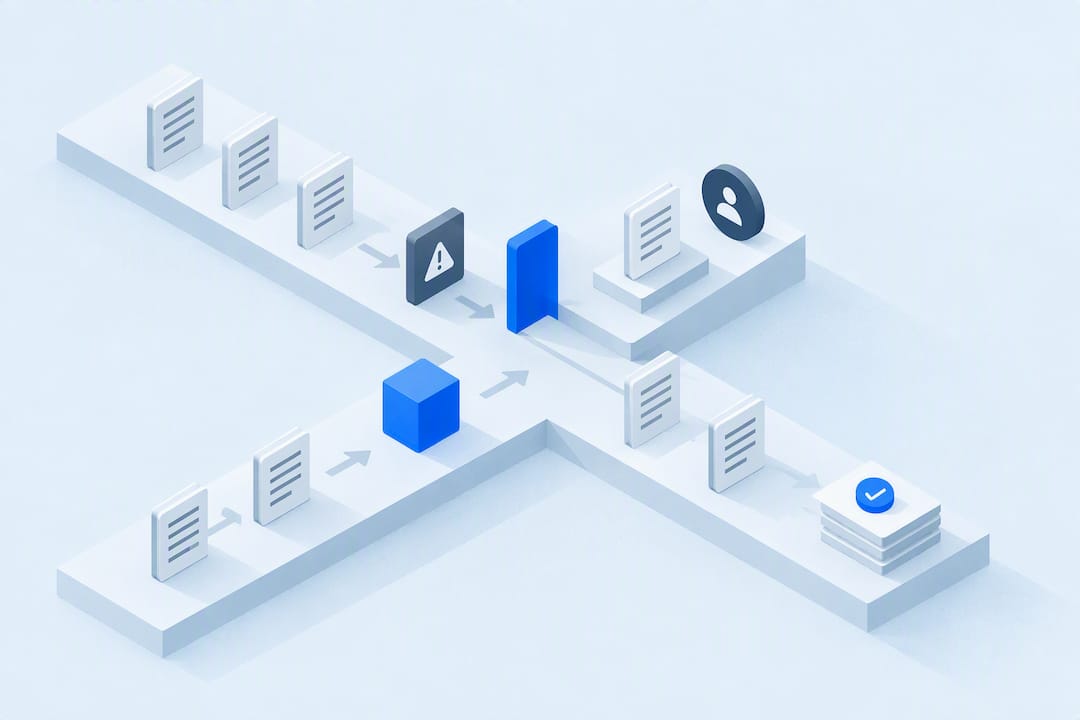
A governance-first playbook for professional services: map workflows, run read-only pilots, and use guardrails and an agent register to reduce AI agent risk.
AI agent risk is the exposure created when an autonomous system holds delegated authority to access systems and take action with limited human oversight. It differs from single-model risk because agents chain steps, retain memory, and touch multiple systems at machine speed. The immediate priority is simple: inventory every agent running in your organisation, then restrict its privileges and require approval for anything consequential before it runs unsupervised again.
TL;DR:
- Most agent incidents stem from broad permissions, shared infrastructure, and skipped approval steps, not sophisticated cyber attacks or model flaws.
- Implementing layered guardrails, human approvals, and runtime monitoring is essential to control risks from prompt injection and tool misuse.
- Starting with low-risk pilot projects using read-only or draft outputs helps build accountability and prevents costly errors in live systems.
- Maintaining a detailed agent registry, mapping workflows, and enforcing least privilege are critical to minimizing cascading failures and operational risks.
- Rapid incident response requires predefined containment, preservation of logs, and thorough root cause analysis to prevent recurrence.
Table of Contents
- What are the main AI agent risks security teams face?
- Where does agent risk actually come from?
- What controls actually reduce AI agent risk?
- How should professional-services firms pilot AI agents safely?
- What should you do when an agent incident happens?
- How Pattrn Data puts these controls into practice
- The mental model needs to change, not just the tooling
- Ready to pilot AI agents without losing control?
- Sources
- FAQ
What are the main AI agent risks security teams face?
Agents fail differently to chatbots. A chatbot that gives a wrong answer wastes someone’s time. An agent that acts on a wrong instruction can send an email, move money, delete a record, or grant access, all before a human notices. OWASP’s Top 10 for Agentic Applications sets out the core taxonomy defenders now work from, and it maps closely to what shows up in real deployments.
Prompt injection and hidden instructions. Agents that read documents, browse the web, or call other tools will often treat whatever they find as trusted input. A client PDF with a hidden instruction, a web page with invisible text, or a poisoned tool response can redirect an agent’s behaviour without anyone typing a malicious prompt directly. OWASP’s guidance on prompt injection recommends treating all external content as untrusted by default, precisely because agents cannot reliably distinguish instructions from data on their own.
Identity and privilege abuse. Agents frequently inherit tokens, sessions, or connector permissions scoped for a human user, not a machine that runs continuously. A support agent connected to a mailbox, a CRM, and a file share can end up holding the combined privileges of all three, which is far more than any single task needs.
Tool misuse and unexpected execution. Natural-language tool invocation means an agent can call a function it was never meant to reach, sometimes because a vague instruction resolved to the wrong tool call. Code execution tools are particularly risky here; a small misunderstanding can trigger destructive commands.
Memory and context poisoning. Agents with durable memory carry contamination forward. A false fact, a manipulated instruction, or a corrupted record written into memory today can quietly shape decisions weeks later, long after the original input has been forgotten.
Accelerated data leakage. Exfiltration that once took a careless employee days to complete can happen through an agent in seconds, because the agent already holds the credentials and the workflow logic to move data between systems.
Cascading failures. Multi-agent systems share infrastructure: a retrieval index, an orchestration layer, a shared memory store. A fault in one agent, or one poisoned data source, can propagate across every agent that depends on the same resource.
Human-trust exploitation. Polished, confident-sounding outputs get less scrutiny than they deserve. Reviewers wave through agent-drafted client communications or financial summaries precisely because they read as competent, which is exactly when errors slip past the person meant to catch them.
Beyond this list, OWASP’s framework also flags goal hijacking, insecure inter-agent communication, and rogue agents acting outside their intended scope, each with its own mitigation path defenders can build against.
Where does agent risk actually come from?
Most agent incidents trace back to a small set of architectural and operational decisions made early, often before anyone thought of them as security choices.
-
Shared infrastructure as a single point of failure. Retrieval indexes, memory stores, and orchestration layers are frequently shared across multiple agents to save on setup effort. That efficiency becomes the exact channel through which one compromised or poisoned component contaminates every agent that reads from it.
-
Delegation chains that break attribution. When Agent A asks Agent B to ask Agent C to update a record, accountability blurs. Least privilege assumes you know who is asking for what, and delegation chains routinely obscure that.
-
Connector and service-account permissions that are broader than the task. Integrations are usually configured once, for convenience, with access far wider than any individual agent task requires. Microsoft’s agent governance guidance is explicit that least privilege has to be enforced deliberately, because default connector setups will not do it for you.
-
Insufficient observability across agents and their messages. Many teams can see what a single agent did but not the messages passed between agents, which is where coordination failures and emergent behaviour actually happen.
-
Non-determinism and drift beyond point-in-time testing. An agent tested safely in a lab can behave differently a month later, after a model update, a new tool integration, or a shift in the data it retrieves. NIST’s AI Risk Management Framework frames this correctly as a socio-technical problem, not a one-off testing exercise, which is why it calls for ongoing risk tracking rather than a single sign-off.
Stanford’s work on agent risk classification adds a useful distinction here: internal workflow agents create privileged-action-at-scale risk, while customer-facing or external agents add reputational and regulatory exposure on top. The controls you need depend heavily on which side of that line your agent sits.
What controls actually reduce AI agent risk?
Guardrails for AI agents work best as a stack, not a single gate. OpenAI’s own guidance on agent guardrails and approvals describes three distinct layers, and each does a different job.
Layer one: automatic guardrails. These check inputs, outputs, and tool calls before anything reaches a person. They catch the routine cases (obviously malformed requests, disallowed tool arguments, outputs that fail a policy check) without needing a human in the loop every time.
Layer two: human approval for sensitive actions. Anything consequential (sending client communications, moving funds, changing access permissions, deleting records) should pause for a person to confirm before it executes. This is the layer most SMEs skip under time pressure, and it is the one that catches what guardrails miss.

Layer three: runtime monitoring with intervention. Someone or something needs to be watching the agent while it runs, with the ability to intervene mid-task, not just review a log afterwards.
Alongside that stack, a handful of design principles do most of the practical work:
- Give every tool integration its own scoped service account rather than reusing a human’s broad credentials.
- Treat all retrieved or external content as untrusted, and keep instructions structurally separate from data wherever your tooling allows it.
- Constrain tool arguments tightly rather than letting an agent construct arbitrary parameters.
- Run adversarial testing and red teaming against prompt injection and credential compromise scenarios, not just happy-path tasks. NCSC’s guidance on agentic AI recommends assuming agents will behave differently than intended and testing accordingly.
- Maintain an agent registry with identity, owner, and audit trail for every agent, so an action can always be traced back to a person accountable for it.
- Sandbox any agent with write access to production systems until its behaviour under adversarial conditions is well understood.
Sandboxing reduces the blast radius of a failure, but NCSC is clear that it is not a complete control on its own. It sits alongside assessing how much autonomy an agent genuinely needs, understanding what safeguards are already built into the tools you’re using, logging every action, and keeping an emergency shutdown capability ready at all times.
Pro Tip: Design your approval step so the reviewer sees the underlying data and reasoning, not just a polished summary the agent has already written for them. Automation bias is real: a fluent, confident-looking draft gets rubber-stamped far more often than a rough one, even when the rough one is more accurate.
Memory deserves separate attention. Writes to durable memory change future behaviour, so memory needs provenance tracking, validation before it’s trusted, an expiry date, periodic review, and a reliable way to delete or roll back contaminated state once you find it. An agent that “remembers” a client’s incorrect billing address for six months is a small version of the same failure that, at scale, becomes a serious data integrity problem.
If your organisation is weighing up how AI tools connect into existing systems, mapping governance and workflow controls before adding new connectors keeps this stack from becoming unmanageable later.
How should professional-services firms pilot AI agents safely?
The biggest mistake SMEs and professional-services firms make with agentic AI is starting with a live, write-enabled deployment because it feels faster. It rarely is, once you count the cleanup.
-
Map the workflow and data boundaries first. Before selecting a tool, document exactly what the current manual process does, which systems it touches, and which data categories it involves. Agents built on top of an unmapped workflow inherit all its existing ambiguity.
-
Classify actions by risk before you automate them. Reading a mailbox and drafting a summary is low risk. Sending an unreviewed email to a client, or updating a compliance record, is not. Decide which category each task falls into before deciding whether an agent gets write access.
-
Start with automated follow ups that actually win clients back in read-only or draft-producing pilots. Inbox triage, document classification, and draft report generation are sensible starting points because a human still reviews and approves the output before anything leaves the system. Client follow-up drafting is another common, low-risk entry point.
-
Define prohibited actions and approval points explicitly, in writing, before the pilot begins, rather than discovering them by incident.
-
Use test data, not live client data, for early runs. This protects clients while the agent’s actual behaviour under real-world variability is still unknown.
-
Build and maintain an agent register. For every agent in production, record its owner, purpose, tools, permissions, data sources, retention rules, and rollback method. NCSC’s guidance recommends documenting jurisdiction, human approval points, failure modes, and incident contacts before an agent ever reaches production, not after.
-
Set a measurement plan before go-live, tracking false positives, unsafe attempts caught by guardrails, the rate of escalation to human review, and audit completeness across the pilot period.
-
Define the criteria that unlock write access. A pilot only graduates from draft-producing to write-enabled once it has run cleanly against those measurements for an agreed period, with no unexplained escalations.
Pro Tip: Firms that skip the read-only pilot stage almost always end up rebuilding their agent register retroactively, once someone asks “which agent touched this record?” during a client complaint. Build the register on day one; it’s far cheaper than reconstructing it under pressure.
Reviewing what a vendor due diligence questionnaire should ask before you onboard a new agent tool is worth doing at this stage too, since supply-chain gaps in the tool itself often surface only once a pilot is already underway.
What should you do when an agent incident happens?
Agent incidents move fast, so the response has to be pre-planned, not improvised. NCSC’s guidance on agentic AI sets out a clear “pull the plug” sequence, and it’s worth having this written down somewhere your team can find in under a minute during a live incident.
- Contain immediately: revoke tokens, disable connectors, stop any queued jobs, and freeze outbound communication from the affected agent.
- Preserve logs and traces before anything is cleaned up or restarted, since these are what a root cause analysis will depend on.
- Identify every changed record and affected workflow, not just the one that triggered the alert; agents that share memory or infrastructure can affect adjacent workflows silently.
- Assess whether memory or state needs purging or rolling back. If the agent wrote contaminated data into shared memory, downstream agents may need the same treatment.
- Notify internally and, where the incident involves client data or regulated information, assess your reporting obligations early rather than after containment is finished.
- Run a proper post-incident review: root cause, which control layer failed, and what specific hardening closes the gap before the agent runs again.
Building audit trails for AI-assisted workflows before an incident happens, rather than after, is what makes step two of this sequence actually possible.
How Pattrn Data puts these controls into practice
Pattrn Data’s approach starts where this article does: mapping the workflow before touching the tool. The Pattrn Protocol sets data boundaries, defines approval points, and keeps a named human accountable for every consequential decision an agent could otherwise make unsupervised.
In practice, that means starting clients with the same read-only pilots described above: Copilot-based inbox triage, draft report generation, and document classification, each reviewed before anything reaches a client. Firms exploring this path can look at how AI agents are built for professional services with exactly this staged, low-risk approach in mind.
The mental model needs to change, not just the tooling
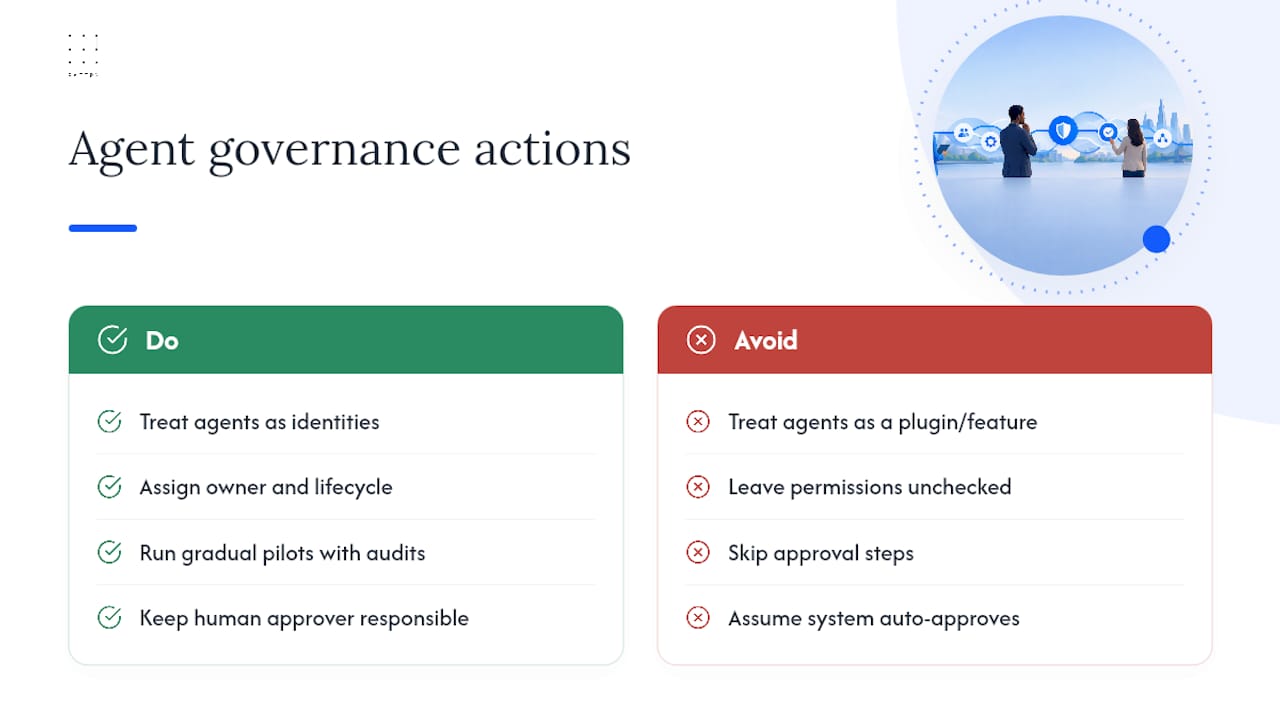
Most organisations still treat AI agents like software features: deploy, monitor for bugs, patch when something breaks. That model doesn’t fit an agent holding delegated credentials across three systems. Agents need to be treated as identities, with a lifecycle, an owner, and a named person accountable for every action, the same discipline applied to a new employee’s access rights, not a new plugin.
The uncomfortable truth is that most agent incidents aren’t caused by sophisticated attacks. They’re caused by permissions nobody revisited and approval steps skipped because the draft looked convincing. Gradual pilots with real audit trails aren’t a slower path to value; they’re the only path that doesn’t require rebuilding trust from scratch after the first failure. Judgement stays with the person who approves the action, not the system that drafted it.
— Rohit
Ready to pilot AI agents without losing control?
Pattrn Data is the alternative to bolting agents onto your systems and hoping the defaults hold: we map your actual workflow, set the data boundaries first, and keep a human approving anything consequential before it goes live. That’s the governance-first difference behind everything in this guide.

An AI Clarity Session costs £497 one-off and gives you a clear map of where agents could safely enter your workflow, and where they absolutely shouldn’t yet. For firms with more complex systems or existing shadow AI use, the SME Audit goes deeper, covering your full agent inventory, permissions, and approval gaps. Teams wanting a contained agent workspace rather than a full build can look at Artha, Pattrn Data’s private AI agent workspace available as a subscription with setup fees. Book a discovery call to talk through which pilot pattern fits your workflow before you connect a single agent to a live system.
Sources
Recommended
Frequently asked questions
What are the main risks of AI agents?
The core risks are prompt injection, identity and privilege abuse, tool misuse, memory poisoning, data exfiltration, cascading failures across shared infrastructure, and human-trust exploitation where a fluent output bypasses proper review. OWASP’s Agentic Top 10 sets out the full taxonomy with mitigations for each.
What are the disadvantages of AI agents compared with standard AI tools?
Agents hold delegated authority to act across systems, which means a single error can cascade into a real-world action rather than just a wrong answer on screen. They also retain memory and chain tasks, so a small flaw can compound over time rather than resetting with each new prompt.
How secure are AI agents in practice?
Security depends entirely on the controls wrapped around them, not the underlying model. A well-governed agent with least-privilege access, sandboxing, and human approval gates is materially safer than one deployed with broad permissions and no review step, which is why frameworks from NCSC and Microsoft both centre on registries, observability, and least privilege rather than the model itself.
What are the four main types of AI risk professional-services firms should track?
A practical grouping covers technical risk (prompt injection, tool misuse), identity and access risk (privilege abuse, connector overreach), operational risk (cascading failures, memory poisoning), and governance risk (unclear ownership, missing audit trails). Mapping each agent against these categories is a faster starting point than trying to assess risk in the abstract.
How can a firm start mitigating AI agent risk without a large security team?
Start with a read-only or draft-producing pilot, an agent register, and clear approval points before granting any agent write access to live systems. A structured AI Clarity Session at £497 is designed to map that first pilot without requiring in-house security expertise.
Choosing AI tools for your practice?
Book a free 30-minute discovery call to talk through the risks and options with Rohit. Use the deeper service links only when you already know the decision needs audit, governance or implementation support.
AI governance consulting
Create policies, approval routes, ownership and controls that teams can actually use day to day.
AI governance consultingAI workflow automation
Turn repeatable admin, client service and reporting work into controlled workflows with clear human review points.
AI workflow automation supportAI Risk & Efficiency Audit
Map real workflows, AI use, data exposure, opportunity value and governance controls before buying or building more tools.
book the AI Risk & Efficiency Audit