
Map Workflows First: AI Change Management for Professional Services

Short answer
A quick answer first, then the fuller context below.
A governance first field guide for professional services: map workflows before buying tools, run a 6–12 week pilot, and keep humans in the loop.
AI change management is the disciplined, people-centred process of embedding AI into workflows while preserving human judgement and measurable governance. It is distinct from implementation, which is buying and configuring a tool, and adoption, which is whether people actually trust and use it well. The next step is never a bigger rollout. It is a small, controlled pilot mapped to one real workflow, with governance built in from day one.
TL;DR:
- Effective AI change management requires mapping workflows, setting clear success criteria, and designing governance before deploying any tools.
- Trust issues, unclear ownership, and poor integration are common organizational barriers that cause AI adoption to stall, not technical limitations.
- A six to twelve-week pilot focusing on a single decision point, with defined metrics and feedback loops, provides actionable insights without delaying progress.
- Ongoing governance, including oversight committees and human-in-the-loop rules, is essential for safe, sustainable AI integration beyond initial launch.
- Continuous learning, staff reskilling in judgment calibration, and tailored communication are key to maintaining momentum and managing resistance in AI adoption.
Table of Contents
- Why AI change management matters for professional services firms
- What stops AI adoption from taking hold?
- A practical change-management framework for AI adoption
- How do you govern AI change without slowing everyone down?
- How do you know if AI adoption is actually working?
- A 6 to 12 week pilot roadmap you can actually run
- Adapting established change models for AI adoption
- Reskilling staff to work alongside AI, not against it
- Communicating AI change without triggering panic or false confidence
- Case studies: how different sectors handled AI change
- Building a culture that keeps learning as AI evolves
- Pattrn Data’s perspective on making AI change stick
- Where Pattrn Data fits in your next step
- Sources
- FAQ
Why AI change management matters for professional services firms
Firms that treat AI as a procurement decision rather than a change programme usually get quiet failure: licences bought, logins created, nothing changing in how the work actually gets done. The organisations making genuine progress with AI are, more often than not, the ones that are good at managing change, not the ones with the newest tools, as Forbes has argued.
Done properly, disciplined change management around AI delivers benefits that are hard to get any other way:
- Continuous visibility. AI systems can surface usage patterns and sentiment signals that show where adoption is stalling weeks before a survey would catch it, using predictive analytics and NLP applied to usage logs.
- Personalised support at scale. Instead of one training session for everyone, people get help calibrated to how they actually use the tool, which shortens the time to real confidence.
- Early resistance detection. Spotting a team quietly reverting to old habits in week three is far cheaper than discovering it at the six-month review.
- Redesigned task allocation. Once AI is genuinely embedded, work gets reorganised around it. Drafting, checking and approval steps change shape rather than simply speeding up.
None of this replaces professional judgement. It augments the people applying it, catching what would otherwise go unnoticed until it became a problem. The value sits in the visibility and the early warning, not in the technology doing the thinking for anyone.
What stops AI adoption from taking hold?
Most AI initiatives that stall do so for organisational reasons, not technical ones. Analysts have consistently found that treating AI as a plug-and-play deployment, without addressing the human and behavioural side, is what causes projects to stagnate despite capable technology, a pattern TechRadar Pro has documented across multiple sectors.
The predictable blockers tend to cluster around five areas:
- Trust deficits. Staff worry about how their data is used, whether outputs are accurate, and who is actually accountable when an AI-assisted decision goes wrong.
- One-off training that doesn’t stick. A single workshop rarely changes behaviour. Skills need to be built in the flow of daily work, not in a separate session people forget within a fortnight.
- Governance gaps. Nobody has clearly agreed whether HR, IT or the business unit owns AI risk decisions, so nobody enforces anything consistently.
- Bolted-on integration. AI gets added on top of an existing workflow rather than designed into it, which creates duplicate steps and extra admin instead of removing it.
- Leadership drift. Senior sponsors are highly engaged during the launch, then move on to the next priority before checking whether adoption actually held.
Each of these is fixable, but only if it is named early. Firms that skip straight to rollout without mapping these risks tend to discover them the expensive way, mid-project.
A practical change-management framework for AI adoption
A repeatable framework beats a one-off launch plan, because AI adoption is continuous rather than a single event. McKinsey’s five-step approach frames this well: build an outcome-based vision, then reimagine workflows and involve employees as active participants rather than passive recipients of a new system, an approach McKinsey sets out in detail. The sequence below adapts that thinking for document-heavy, judgement-led firms.
- Map the workflow first. Before any tool decision, document the decisions, handoffs, data touchpoints and audit requirements in the process you intend to change. If you cannot draw this on one page, you are not ready to automate it.
- Define outcomes, not features. Set success criteria around what the business actually needs. Faster client responses, fewer manual errors, cleaner audit trails. Never around what the tool technically does.
- Design the guardrails before you switch anything on. Decide data boundaries, human-in-the-loop checkpoints and approval thresholds up front, not as a retrofit once something has already gone wrong.
- Run the pilot on a fixed cadence. Choose named champions, agree a review rhythm, and build in short feedback loops so problems surface in week two, not month six.
- Scale by embedding, not expanding. Widening a pilot only works once AI is genuinely built into daily routines, training happens in the flow of work, and governance cadences are already running, not planned for later.
Pro Tip: Limit your first pilot to a single decision point inside one workflow, not an entire department. A tightly scoped pilot with a clear human review checklist and a recorded audit trail gives you a defensible evidence base before you even think about scaling.
This sequence mirrors principles from established organisational change management: clear communication, genuine participation, reinforcement and measurement all still apply. What changes with AI is that the change itself doesn’t stop after go-live. It needs the same discipline reapplied on a rolling basis, as Culture Amp’s analysis of AI-era change management points out. Firms that start from existing work patterns and informal AI use already happening in teams, rather than replacing everything wholesale, tend to get less resistance and faster genuine uptake.
How do you govern AI change without slowing everyone down?
Governance is not a document you write once and file away. It is a small set of working rules, revisited regularly, that make experimentation safer rather than riskier. Sustainable AI integration requires exactly this kind of continuous oversight: governance cadences, capability measurement and human-in-the-loop checkpoints that run well beyond the initial launch, which is precisely where McKinsey’s guidance on capability decay is most useful.
A workable governance structure usually needs four elements:
- An oversight committee with a fixed cadence. Someone senior owns AI risk tolerance and policy, and reviews it on a schedule, not only when something breaks.
- Explicit human-in-the-loop rules. Define exactly which decisions require sign-off before an AI-assisted output goes anywhere near a client, and at what threshold.
- Clear data rules. Set access, retention and anonymisation standards for anything used in training or inference, especially where client data is involved.
- A disclosure practice. Decide in advance what you tell clients and staff about where AI is used, rather than improvising an answer when someone asks.
Pro Tip: Write your human-in-the-loop threshold as a single sentence a new starter could apply without asking anyone. “Any AI-drafted client communication over £X in scope, or touching regulated advice, needs a named reviewer’s sign-off before it goes out” is far more useful than a ten-page policy nobody reads.
Boards increasingly need a working vocabulary for these questions, and the questions boards should be asking about balancing adoption against risk oversight are a useful starting point for that conversation. Clients and regulators will ask similar questions eventually, and having a clear way to explain your governance approach to them matters more than having a perfect one.
How do you know if AI adoption is actually working?
Licences issued and logins recorded tell you almost nothing. Task completion rates, output quality, time genuinely saved and staff trust in the system tell you everything. That distinction between implementation metrics and adoption metrics is where most measurement efforts go wrong.
A useful measurement set for firms tends to combine three things: usage analytics, a short pulse survey run on a fixed cadence, and a handful of outcome KPIs tied to the workflow the pilot actually touched.
- Adoption velocity. How quickly is genuine, unprompted usage rising across the target team, not just initial logins.
- Change impact on KPIs. Has the metric you set as your success criterion actually moved. Turnaround time, error rate, client response time.
- Trust score. A short, repeated pulse question asking staff how much they trust the AI’s output in this specific workflow, tracked over time rather than measured once.
Deloitte’s playbook for agentic AI adoption uses a similar idea, segmenting staff by trust quotient and mapping engagement at the team level rather than relying on one company-wide number, an approach detailed in Deloitte’s CXO playbook. Set a threshold in advance for when a falling trust score or stalling adoption velocity triggers an intervention, rather than waiting for a quarterly review to notice.
A 6 to 12 week pilot roadmap you can actually run
A pilot that drags on for six months with no defined endpoint rarely produces a clean decision either way. A tighter pilot, run properly, gives you evidence fast enough to act on it.
- Pick one workflow. High value, genuinely low risk if it goes wrong. Client onboarding checks or first-draft correspondence tend to work better than anything touching regulated advice on day one.
- Map it end to end. Every decision point, handoff and piece of data the workflow touches, before you configure anything.
- Agree success criteria and data boundaries up front. What “working” looks like, what data the tool can and cannot touch, and what evidence you need to keep for audit purposes.
- Train in the flow of work. Short, task-specific guidance delivered at the point of use beats a one-off session every time. Nominate two or three change champions inside the team itself.
- Collect feedback on a short cycle. Three feedback sprints across an eight to twelve week window is enough to catch most problems early, without dragging the pilot out indefinitely.
- Decide, then scale deliberately. Update governance based on what the pilot actually showed, and only widen scope once training and oversight are already running smoothly at the smaller scale.
Adapting established change models for AI adoption
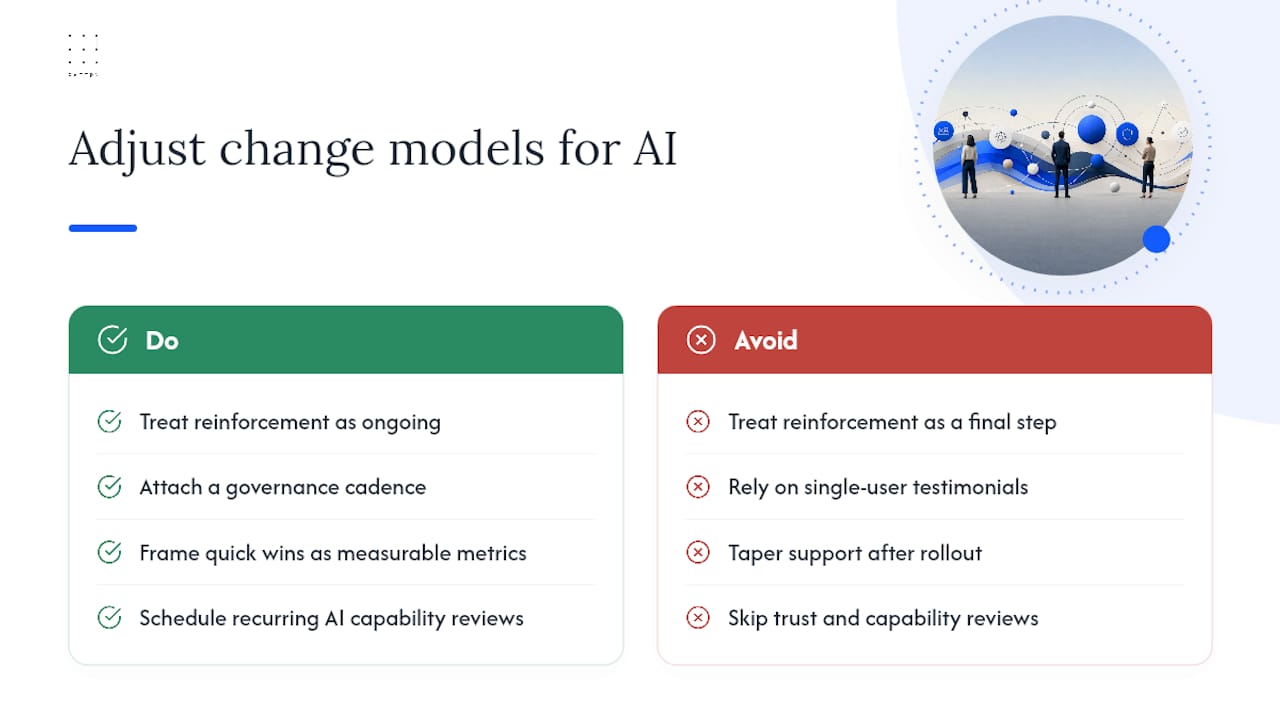
Classic frameworks were not written with AI in mind, but most of them translate with a few deliberate adjustments rather than a full rewrite. Prosci-style approaches, built around awareness, desire, knowledge, ability and reinforcement, still hold up well, provided the “reinforcement” stage is treated as ongoing rather than a final box to tick.
The key adjustment is timing. Traditional change models were designed for discrete, one-off shifts, such as a new CRM system or office relocation. AI adoption behaves differently because the tool itself keeps changing, usage patterns shift as people get more confident, and new capabilities appear without warning. That means the “reinforcement” and “sustain” stages of any classic model need to run continuously, with a genuine governance cadence attached, rather than tapering off after a fixed rollout period.
Kotter’s eight-step model works similarly well if the “generate short-term wins” step is reframed around the pilot metrics from the earlier measurement section, rather than vague enthusiasm. A quick win here is a documented reduction in turnaround time or a measurable drop in manual rework, not a testimonial from one enthusiastic early adopter.
Whichever framework you start from, the adaptation that actually matters is building in a recurring review point specifically for AI capability and trust, something none of the legacy models originally accounted for because the technology they were built for did not keep evolving underneath the team using it.
Reskilling staff to work alongside AI, not against it
Reskilling for AI is not the same exercise as reskilling for a new piece of software. The tool’s output changes with context, prompting and iteration, which means the skill being built is closer to judgement calibration than button-pushing.
Effective reskilling tends to have three characteristics. It happens in the flow of daily work rather than in a classroom, it is specific to the exact workflow the person will actually use AI in, and it includes explicit teaching about where the output is likely to be wrong. Staff who understand the failure modes of a tool trust it appropriately. Staff who are only taught the happy path either over-trust it or abandon it the first time it produces something odd.
Champions embedded in each team matter more here than centralised training functions. A colleague who has already hit the tool’s limits in a specific workflow and can show a peer exactly where to double-check output is worth more than another slide deck. Pairing reskilling with the pilot cadence from earlier means training content updates as the workflow itself evolves, rather than going stale within a few months.
Firms document-heavy in nature, such as accountancy and legal practices, benefit from framing reskilling around specific document types and decision points rather than the tool in the abstract. “How to check an AI-drafted client letter before it goes out” trains something concrete. “How to use our new AI assistant” does not.
Communicating AI change without triggering panic or false confidence
The two failure modes in AI communication sit at opposite ends of the same problem. Say too little, and rumour fills the gap, usually with the worst-case interpretation of what the tool will be used for. Say too much too soon, promising transformation before anything has been proven, and you set an expectation the pilot cannot possibly meet.
A workable communication plan names the fear directly rather than talking around it. If staff are worried about job security, address that explicitly and honestly rather than avoiding the subject. If clients are worried about their data, explain in plain terms what happens to their data when AI is involved rather than issuing a vague reassurance.
Layered communication tends to work better than one company-wide announcement. Deloitte’s concept of microculture mapping, treating different teams as having genuinely different concerns and adoption readiness rather than a single uniform workforce, reflects this well in its CXO playbook for agentic AI. A compliance team and a client-facing sales team need different messages about the same rollout, not because the facts differ, but because their concerns genuinely do.
Timing matters as much as content. Communicate before the pilot starts, again at the midpoint with honest results, and once more at the decision point, rather than only at launch and at the final announcement.
Case studies: how different sectors handled AI change
Patterns vary by sector, but the common thread across successful rollouts is consistent: the organisations that got traction treated AI adoption as a change programme first and a technology deployment second.
In regulated professional services, firms that succeeded generally started with a single, low-risk administrative workflow, such as document intake or first-pass drafting, rather than anything touching client advice directly. That sequencing let them build trust and a governance track record before extending scope into anything higher stakes.
In customer service functions more broadly, the pattern reported across several industries has been similar: predictive analytics and sentiment monitoring applied to existing support channels catch adoption resistance early, well before a scheduled review would surface it, a use case IBM has documented in detail. Teams that combined that visibility with a genuine feedback loop back to the people doing the work saw resistance drop faster than teams relying on top-down mandates alone.
The pattern that repeats across every sector examined is not about the specific technology chosen. It is that the firms making real progress spent as much effort on the human side of the rollout as they did selecting the tool itself, echoing the wider argument that AI strategy is, in practice, a change management strategy.
Building a culture that keeps learning as AI evolves
AI tools change faster than most organisational review cycles, which means a static training programme goes stale within months. The firms that stay ahead treat continuous learning as an operating habit rather than a periodic project.
Practically, that means building short, regular review points into existing team rhythms rather than scheduling a separate annual training day. A fifteen-minute slot in a weekly team meeting to discuss what worked and what didn’t with the AI tool that week does more for genuine capability than an annual refresher course. It also gives the governance committee live signal about where the guardrails need adjusting.
Rewarding people for flagging where AI output was wrong matters more than most leaders expect. Teams that feel safe raising “the tool got this wrong” without it reflecting badly on them will surface problems early. Teams that feel judged for questioning the tool will quietly stop using it, or worse, quietly stop checking it. Wider transformation work, including the kind of operating-model thinking covered by firms like Spicalo, tends to treat this psychological safety point as foundational to any durable change, not just AI specifically.
Innovation during AI integration tends to come from the people closest to the workflow, not from a central innovation function. Giving champions a genuine route to propose small workflow adjustments, and acting on the reasonable ones quickly, keeps the culture active rather than compliant.
Pattrn Data’s perspective on making AI change stick
Most AI change failures we see start with the same mistake: skipping the workflow map and going straight to the tool. Pattrn Data’s approach to AI workflow automation starts the other way round, mapping how the work actually happens, setting data boundaries, and keeping human review in place before any automation goes live.
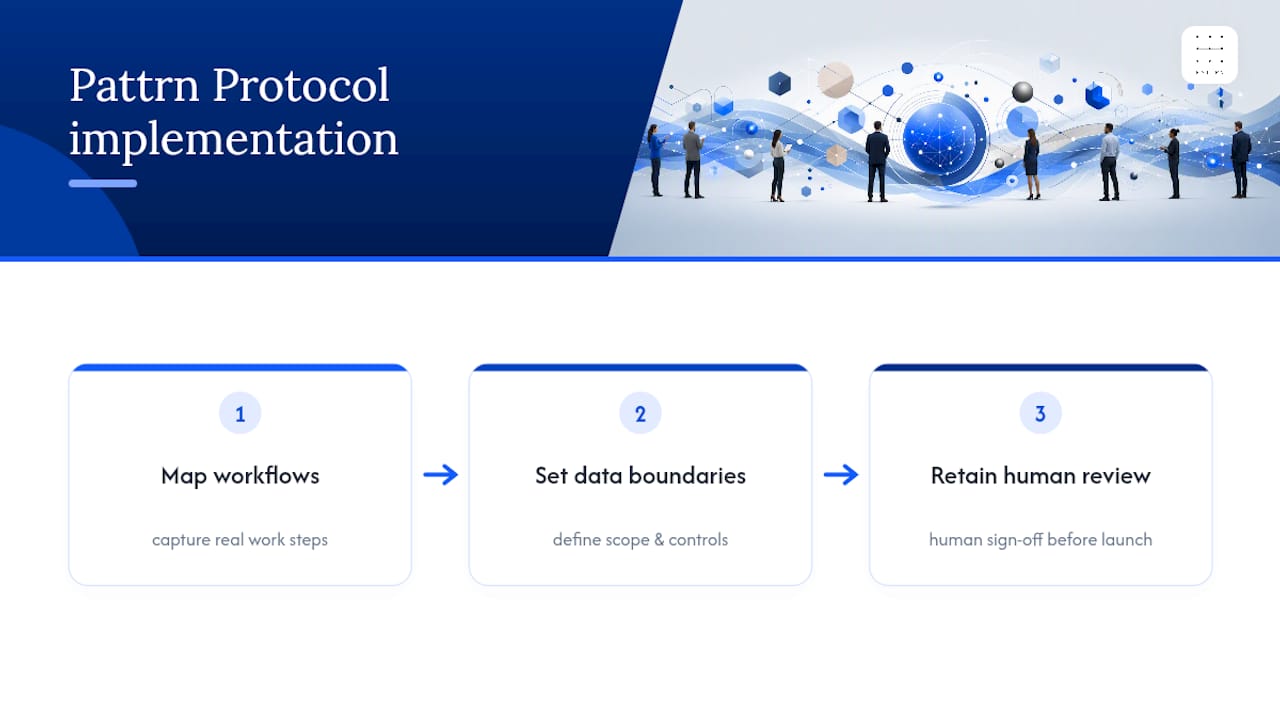
That discipline runs through the Pattrn Protocol, a framework for mapping workflows, setting data boundaries and building safer decision-making around the people still accountable for the outcome. It applies whether the engagement is an AI clarity session, a risk and efficiency audit, or a full Copilot Studio workflow build.
The pattern holds regardless of sector: firms that govern the change well get more out of the technology than firms that simply buy more of it.
— Rohit
Where Pattrn Data fits in your next step
If the framework above makes sense but you are not sure where to start mapping your own workflows, that is exactly the gap Pattrn Data’s AI clarity sessions and risk and efficiency audits are built to close. A first engagement typically starts with an audit of how AI and automation are actually being used across your firm, including any shadow AI nobody has formally sanctioned, followed by a practical roadmap and support running your first controlled pilot.
Expect three things from that first conversation: a clear picture of where time and judgement are currently being lost, a scoped pilot recommendation tied to one real workflow, and a governance structure sized to your firm rather than borrowed from a much larger organisation. If audit trails and evidence for regulated decisions are a live concern, building auditable AI workflows without relying on scattered spreadsheets is often the fastest place to start. For firms wanting ongoing oversight rather than a one-off project, Pattrn Data’s AI governance consulting provides the retainer-based cadence the frameworks above depend on. Book an initial AI clarity session to find out exactly where your firm’s biggest AI risk and opportunity actually sit.
Sources
Recommended
Frequently asked questions
What is AI change management?
AI change management is the structured, people-focused process of embedding AI tools into existing workflows while keeping human judgement and oversight in place. It differs from implementation, which is simply installing or licensing a tool, and from adoption, which measures whether staff genuinely trust and use it.
How is AI change management different from digital transformation?
Digital transformation AI projects often focus on broad technology upgrades across systems. AI change management is narrower and more workflow specific, mapping individual decision points, data flows and approval steps before any tool goes live, following the staged approach McKinsey recommends.
How long does an AI change management pilot take?
Most well-scoped pilots run for six to twelve weeks, covering a single workflow with defined success criteria and a fixed feedback cadence. That timeframe is long enough to gather genuine evidence but short enough to keep momentum and leadership attention.
What is the biggest risk in AI adoption for professional services firms?
Trust deficits and unclear governance ownership are the most common blockers, often causing adoption to stall even when the technology itself works well. TechRadar Pro’s analysis found these organisational issues, not technical ones, are the usual cause of failed rollouts.
Can Pattrn Data help run our first AI pilot?
Yes. Pattrn Data runs AI clarity sessions and risk and efficiency audits that map your workflows, set data boundaries, and support a first controlled pilot with governance built in from the start. Current pricing and service scope are listed on the AI governance consulting page.
Choosing AI tools for your practice?
Book a free 30-minute discovery call to talk through the risks and options with Rohit. Use the deeper service links only when you already know the decision needs audit, governance or implementation support.
AI governance consulting
Create policies, approval routes, ownership and controls that teams can actually use day to day.
AI governance consultingAI Risk & Efficiency Audit
Map real workflows, AI use, data exposure, opportunity value and governance controls before buying or building more tools.
book the AI Risk & Efficiency AuditAI workflow automation
Turn repeatable admin, client service and reporting work into controlled workflows with clear human review points.
AI workflow automation support