
Build an AI Governance Board in 90 Days With a Workflow Map
Short answer
A quick answer first, then the fuller context below.
Make your board ready to govern AI: appoint a sponsor, map workflows, and run a 90 day pilot with audit trails and human review gates.
If AI already influences credit decisions, client advice, underwriting, or pricing in your organisation, you need a board-level AI oversight body now, not after the next incident. Start with an AI systems inventory, name an executive sponsor, and run a 90-day controlled pilot before writing any wider policy. Recognised frameworks from the European AI Act and the KPMG and INSEAD board principles both point the same way: govern the posture, not the code.
TL;DR:
- Organizations with AI influencing critical decisions should establish a board-level oversight body, starting with an inventory and a controlled pilot within 90 days.
- An AI governance board must include roles such as a chair, executive sponsor, AI lead, security, legal, risk, and operational representatives to ensure effective oversight.
- The board’s charter should specify scope, decision rights, escalation triggers, confidentiality, and review cycles, with quarterly meetings for regulated firms.
- AI risk overlaps with existing operational, legal, and reputational risks, requiring assurance mechanisms like validation, audit trails, incident reporting, and change control.
- Starting small through a pilot with clear workflows and documented metrics is more effective than drafting broad policies before understanding actual AI use.
Table of Contents
- What is an AI governance board and when do you need one?
- Who should sit on the AI oversight committee?
- What should the board charter actually say?
- How does AI oversight fit into enterprise risk management?
- How do you set up an AI governance board in 90 days?
- What red flags should the board watch for?
- The Pattrn Protocol: turning governance principles into assurance
- The gap between AI governance principles and what boards actually do
- Get board-ready AI governance without losing control of judgement
- Sources
- FAQ
What is an AI governance board and when do you need one?
An AI governance board is the body that sets strategic direction for AI use, owns AI risk appetite, and holds management to account for how AI systems are built, bought, and deployed. Its remit typically spans four areas: strategy and investment, risk and assurance, vendor and third-party oversight, and clear lines of human accountability for AI-influenced decisions.
Not every organisation needs a standalone committee. The decision usually turns on:
- Materiality: does AI touch decisions with financial, legal, or client-facing consequences?
- Regulatory exposure: are you operating across borders where obligations under the EU AI Act or equivalent regimes apply?
- Third-party dependence: how much of your AI capability sits with external vendors you don’t control?
- Scale of use: is AI confined to one team, or spreading across the business through tools like Copilot?
A ten-person advisory firm with two automated workflows can fold AI oversight into an existing risk committee. A regulated firm running AI across underwriting, advice, and client communications needs a dedicated board-level function. The Corporate AI Governance Code calls this proportionality, and it expects boards to document the judgement, not just make it.
Who should sit on the AI oversight committee?
Membership determines whether an AI governance committee produces real assurance or just meets quarterly and signs off a slide deck. Public sector examples, including the FTC’s data and AI governance board charter, show a consistent core.
- Chair (often a non-executive director): owns the agenda, ensures independence from operational pressure, and signs off the annual review.
- Executive sponsor: a board member accountable for AI outcomes to the rest of the board, not just to management.
- CAIO or nominated AI lead: brings the technical inventory, model performance data, and vendor status to every meeting.
- CISO: reports on security posture, access controls, and incident data specific to AI systems.
- General counsel: flags regulatory exposure and reviews contracts with AI vendors before they’re signed.
- CFO or head of risk: quantifies financial exposure and links AI risk into the wider risk register.
- Business unit owners: report on where AI is actually being used day to day, including tools staff have adopted without formal sign-off.
Independent technical advisers or an external auditor can sit outside the core group, brought in for specific reviews rather than every meeting. Each role should arrive with something concrete: a paper, an assurance check, or a KPI update, not a verbal summary.
Pro Tip: Ask each member to bring one metric they’d stake their reputation on. If nobody can name one, the committee is meeting without substance.
What should the board charter actually say?
A charter that reads like a mission statement is worthless in an audit. It needs operational clauses that tell people what to do when something goes wrong.
- Scope: which AI systems, decisions, and business units fall under the committee’s authority.
- Decision rights: what the committee can approve directly versus what it escalates to the full board.
- Escalation triggers: named thresholds (a materiality banding, a specific incident type) that force an out-of-cycle meeting.
- Confidentiality and conflicts: how vendor relationships and internal conflicts of interest get disclosed and managed.
- Review cycle: an annual charter review, at minimum.
On cadence, the FTC’s own charter sets quarterly meetings as a floor for regulated bodies. Each meeting pack should include an updated AI systems inventory, any incidents since the last meeting, material vendor changes, and an assurance summary covering validation and audit trail checks. Boards that only meet twice a year on AI risk tend to find out about problems from a client complaint or a regulator, not from their own reporting.
How does AI oversight fit into enterprise risk management?
AI risk isn’t a new risk category bolted onto the register. It maps directly into categories most risk committees already track: operational risk (system failure, poor output quality), model risk (drift, bias, unvalidated assumptions), legal and regulatory risk, reputational risk, and concentration risk where too much depends on one vendor.
The board should demand specific assurance mechanisms rather than accept assertions:
- Independent validation of any model used in a material decision, separate from the team that built it.
- Audit trails showing what data went in, what decision came out, and who reviewed it.
- Incident reporting with defined severity bands and response times.
- Change control so nobody updates a production AI system without sign-off.
The European Artificial Intelligence Board sits within a wider EU structure that includes a Scientific Panel and an Advisory Forum of 174 members drawn from over 700 applicants, an example of governance built for scale rather than a single company. Most SMEs don’t need that architecture. What they do need is the same discipline in miniature: proportionate assurance, documented, and reviewed on a cycle the board actually keeps.
How do you set up an AI governance board in 90 days?
Boards that wait for a complete policy before acting usually never act. The faster route is a bounded pilot that produces real evidence within one quarter.
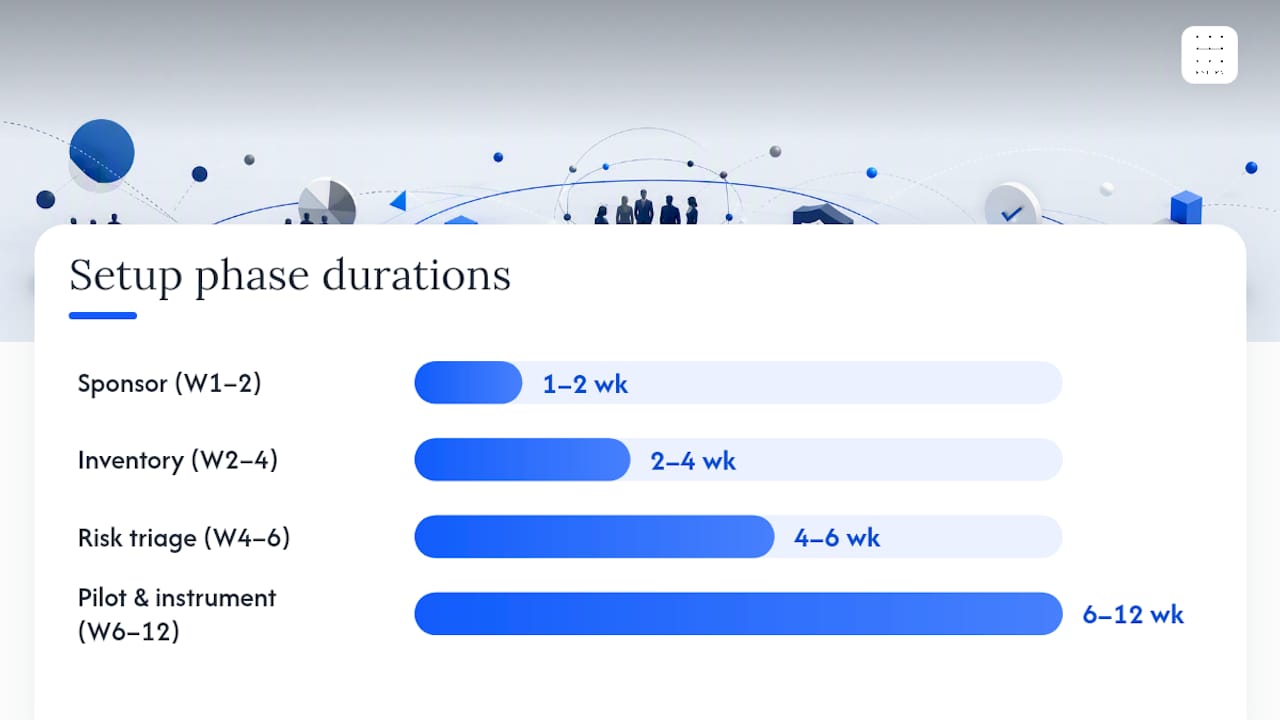
- Weeks 1 to 2: Appoint an executive sponsor and confirm who chairs the committee. Without an accountable individual, nothing else on this list happens.
- Weeks 2 to 4: Build a first-pass AI systems inventory, including tools staff have adopted informally. Shadow AI, spreadsheet macros nobody documented, browser extensions doing translation or summarisation, is usually larger than leadership expects.
- Weeks 4 to 6: Run a rapid risk triage against that inventory. Rank each system by materiality and regulatory exposure, not by how impressive the tool sounds.
- Weeks 6 to 12: Choose one controlled pilot, ideally a workflow with clear human review gates already in place, and instrument it properly: audit trail, defined KPIs, an escalation path if outputs look wrong.
Once the pilot runs, the operating model needs a board pack with consistent contents each cycle: inventory changes, incident log, vendor concentration, and accuracy or exception rates against a defined baseline. A UK government knowledge hub lists an AI systems inventory and operational monitoring among the foundational steps every organisation should have before scaling further, and treats a short initial pilot as the fastest route from principle to practice.
Scaling from pilot to enterprise assurance should happen only once the audit trail and human review gates have proven themselves on the smaller pilot. Moving fast on rollout while skipping that proof step is how governance frameworks end up as documents nobody follows.
What red flags should the board watch for?
Micromanagement is a bigger risk than most boards expect: a committee that tries to approve every model tweak burns credibility and slows down legitimate work, while missing the actual dangers.
- Shadow AI: tools adopted by staff outside any inventory or review process.
- No audit trail: decisions made with AI input that can’t be reconstructed after the fact.
- Unclear accountability: nobody can say who owns the outcome when an AI-assisted decision goes wrong.
- Weak supplier controls: vendor contracts with no data handling clauses or exit provisions.
Pro Tip: If your board pack can’t answer “who reviewed this output and when,” that’s the first gap to close, before adding a single new tool.
The Pattrn Protocol: turning governance principles into assurance
Principles are easy to write and hard to operate. Pattrndata built the Pattrn Protocol around that gap: a sequence that maps the actual workflow before touching any tool, sets clear data boundaries, keeps a human review gate at the decision point, and instruments an audit trail so every output can be traced back to its source.
In practice, that sequence produces the artefacts a board actually needs to see:
- A workflow map showing where AI enters a process and where a person still signs off.
- A minimal systems inventory scoped to what’s materially in use, not a theoretical catalogue.
- A short pilot with defined KPIs and an audit trail built in from day one.
- A compact board pack that turns technical detail into decisions the board can actually make.
An AI clarity session or a fixed-scope audit typically produces the first version of that inventory and pilot plan within weeks, giving the board something concrete to govern rather than a policy document sitting unread in a folder.
The gap between AI governance principles and what boards actually do
Most AI governance guidance stops at principle. It tells boards to demand oversight, assign accountability, and require assurance, and then leaves the “how” to whoever gets handed the task. That’s where most efforts stall: someone drafts a policy, nobody maps the workflows it’s supposed to govern, and six months later the policy describes a business that doesn’t exist anymore.

The conventional advice also overrates committee structure and underrates sequencing. A perfectly staffed AI oversight committee with no systems inventory is worse than a smaller group that actually knows what’s running in the business. Structure without an inventory is theatre.
What the evidence in this piece actually supports is starting small and specific: one sponsor, one inventory, one pilot with a human review gate and an audit trail, before any wider policy gets written. Boards that reverse that order, policy first, detail later, tend to produce documents that read well and change nothing. The workflow map should always come before the governance framework, not after it.
— Rohit
Get board-ready AI governance without losing control of judgement
Pattrndata works with boards and leadership teams who need the inventory, pilot plan, and board pack described above, not another policy template. An AI Clarity Session is designed to provide a first-pass systems inventory, a risk triage, and a pilot plan your committee can actually govern. Please refer to Pattrn Data’s pricing page for current fees.

For firms already running AI across multiple teams, an SME Audit or Established Business Audit goes deeper, mapping workflows before recommending any tool. Boards that want ongoing assurance rather than a one-off engagement can move to a governance retainer, which keeps the inventory current, the audit trail instrumented, and the board pack arriving on schedule. Current prices can be found on Pattrn Data’s pricing page. Book the clarity session first. Everything else builds from what it finds.
Sources
Recommended
Frequently asked questions
What Is an AI Governance Board?
An AI governance board is a board-level committee that sets strategy, risk appetite, and accountability for how an organisation builds, buys, and deploys AI systems. It typically includes an executive sponsor, a technical lead, legal, risk, and business representation, following patterns seen in charters like the FTC’s.
What Are the Six Pillars of AI Governance?
Definitions vary across frameworks, but recurring themes include strategic oversight, risk and assurance, workforce transformation, trustworthy and ethical use, security oversight, and clear board-level accountability. The KPMG and INSEAD framework sets out five core principles covering most of this ground rather than a fixed six.
Which Jobs Are Most Exposed to AI Disruption?
No credible source names three specific jobs that “will not survive” AI, and any list claiming otherwise should be treated with scepticism. Roles built entirely around repetitive data entry or basic transcription face the most disruption, while judgement-heavy roles in advice, compliance, and client relationships remain harder to automate and typically need human review built in regardless.
Who Are the Major Players Shaping AI Governance Standards?
There’s no single agreed “big four” in AI governance the way there is in audit. Standards and guidance come from a mix of regulators (the EU AI Act bodies), consultancies (KPMG working with INSEAD on board principles), and national advisory groups, each covering a different piece of the picture.
Does a Small Business Need a Full AI Governance Committee?
Not necessarily. Proportionality matters: a business with limited, low-materiality AI use can fold oversight into an existing risk or audit committee rather than standing up a separate board. The Corporate AI Governance Code expects the decision to be documented, whichever way it goes.
What Does Pattrndata’s AI Clarity Session Cost?
The AI Clarity Session is a one-off fixed fee of £497, covering an initial systems inventory, risk triage, and pilot plan. Ongoing governance support is available through retainers starting from £1,500 per month, listed on the pricing page .
Choosing AI tools for your practice?
Book a free 30-minute discovery call to talk through the risks and options with Rohit. Use the deeper service links only when you already know the decision needs audit, governance or implementation support.
AI governance consulting
Create policies, approval routes, ownership and controls that teams can actually use day to day.
AI governance consultingAI Risk & Efficiency Audit
Map real workflows, AI use, data exposure, opportunity value and governance controls before buying or building more tools.
book the AI Risk & Efficiency AuditAI workflow automation
Turn repeatable admin, client service and reporting work into controlled workflows with clear human review points.
AI workflow automation support