
How Professional Firms Win: Governance First AI in Regulated Industries

Short answer
A quick answer first, then the fuller context below.
Governance-first steps to deploy AI in regulated industries. Inventory models, run a small pilot, enable immutable logging, and package audit ready...
Responsible AI in regulated industries is governed AI: audit-ready logs, documented model lineage, and human oversight are non-negotiable, not optional extras bolted on after launch. If you deploy a model in finance, healthcare, pharma, or legal services without those three elements in place, you have built a liability, not a capability. The single next action is straightforward: inventory every AI system currently touching a regulated decision before you build or buy another one.
TL;DR:
- Prioritize immutable inference logs that record inputs, model version, and outputs for every regulated decision to enable auditability and explainability at the moment of inference.
- Ensure data residency is strictly controlled by knowing precisely where inference occurs, not just where data is stored, to prevent compliance breaches.
- Maintain a validated, version-locked model to simplify regulatory review and differentiate between models that keep learning and those that are fixed and auditable.
- Build a comprehensive inventory of all AI systems touching regulated workflows, with clear ownership and documented validation testing, before deploying new models.
- Adopt a phased approach from pilot to production that includes risk tiering, small controlled pilots, thorough validation, and formal evidence capture to avoid regulatory scrutiny and costly gaps.
Table of Contents
- Why AI in regulated industries needs a different build
- The regulatory landscape: what deployers must prove
- Core risks and the controls regulators actually expect
- A phased roadmap from pilot to audit-ready production
- How Pattrn Data applies a governance-first approach
- What AI regulation does to innovation and strategy
- What successful deployment actually looks like
- Where AI regulation is heading next
- Author perspective: three leadership priorities for adopting AI safely
- Book a clarity session or audit with Pattrn Data
- Sources
- FAQ
Why AI in regulated industries needs a different build
General software deployment tolerates ambiguity. AI in regulated industries does not, because the cost of an unexplainable decision is a fine, a lawsuit, or a licence review. Cross-border API calls that route personal health information or material non-public information through a third-party model provider can breach data residency rules before anyone notices, since the request never touches a server the compliance team logged. Standard application logs record that a call happened. They do not record which model version produced the output, what data shaped that specific inference, or whether a human reviewed it before it reached a client.
That gap is why immutable inference logging matters more than uptime dashboards in these sectors. Explainability also has to work at the moment of decision, not as a summary written month later.
- Data residency: know exactly where inference happens, not just where data is stored
- Immutable logs: capture inputs, model version, and output for every regulated decision
- Runtime explainability: generate the “why” alongside the answer, not after a complaint
- Model stability: distinguish a validated, frozen model from one that keeps learning in production
A continuously learning model is a moving regulatory target. A validated, version-locked model is something an auditor can actually assess.
The regulatory landscape: what deployers must prove
The EU AI Act sets the pace for most global compliance planning, even for firms outside the EU, because high-risk AI systems face conformity assessments, transparency duties, and documentation obligations with deadlines running through August 2026. Under Article 101 of the EU AI Act, general-purpose AI providers face fines of up to €15 million or 3% of global turnover for compliance failures, with steeper penalties for prohibited practices
Sector rules layer on top of that. Pharma and medical device teams work against FDA guidance that leans risk-based and flexible, which sits uneasily against the EU’s more prescriptive posture. A 2026 review in Springer’s AI and Ethics journal documented that tension directly and proposed a seven-stage IVEL framework for validating and managing AI across its lifecycle in GxP contexts. Finance has its own long-standing expectation, model risk management under frameworks like SR 11-7 in the US, now being reread through an AI lens by supervisors who want governance and explainability built into the system, not added afterwards, according to a Bank for International Settlements working paper.
What examiners actually ask for:
- A model inventory with owners named against each system
- Evidence of validation testing and subgroup performance checks
- Data processing agreements and transfer safeguards for cross-border flows under GDPR or UK GDPR
- Logs proving a human reviewed automated decisions where required
If you cannot produce these within days of a request, the gap itself becomes the finding.
Core risks and the controls regulators actually expect
Every AI risk in a regulated sector traces back to one of five failure modes, and each has a matching control that examiners now look for by name.
- Privacy and third-party risk. Map every data flow before a vendor contract is signed, attach a data processing agreement, and confirm transfer safeguards for any cross-border route. Skipping this step is the single most common finding in vendor risk reviews.
- Auditability gaps. Immutable inference logs, checksummed model versions, and captured decision lineage let you reconstruct exactly what happened and when, a requirement flagged repeatedly in engineering-level guidance on shipping AI under compliance constraints.
- Explainability failure. Decision-specific explanations, not generic model summaries, paired with a model card maintained per version. A model card written once at launch and never updated is worse than no documentation, because it misleads.
- Weak operational governance. Human review gates, clear escalation paths, information barriers between teams handling conflicting mandates, and regular attestation that reviewers are actually reviewing, not rubber-stamping.
- Security and vendor exposure. Supply-chain checks on model providers, adversarial testing before go-live, and an incident playbook that names who does what in the first hour of a failure.
Some platforms now map a single control to multiple frameworks at once, EU AI Act, ISO/IEC 42001, NIST AI RMF, and GDPR simultaneously, which cuts duplicated evidence work considerably, a pattern documented by multi-framework governance platforms. Runtime enforcement tools that block a prohibited request at the point of inference and stamp it with a rule reference and timestamp are becoming a practical pattern worth studying, illustrated by commercial runtime enforcement products.
Pro Tip: Build your immutable logging and model lineage infrastructure before you touch explainability tooling. It is the lowest-effort, highest-leverage fix, and every later control depends on it existing first.
A phased roadmap from pilot to audit-ready production
Skipping straight to production is how firms end up explaining an undocumented model to a regulator with no evidence trail. A phased approach avoids that, and it does not need to be slow.
- Inventory and risk tiering. List every model touching a regulated workflow, its data inputs, and a named human owner. You cannot govern what you have not mapped, and mapping the data going into your AI tools is the honest starting point most firms skip.
- Design a small, controlled pilot. Pick one workflow, define acceptance tests in advance, set human-in-loop checkpoints, and switch on immutable logging from day one, not after the pilot proves useful.
- Validate and document. Run test matrices across subgroups, check for bias in outcomes, and produce a model card that a non-technical auditor could actually read.
- Operationalise. Set drift detection thresholds, a revalidation calendar, and a governance cadence, monthly or quarterly, that someone is accountable for running.
- Package examiner-ready evidence. Control registers, attestation logs, and version history bundled so a request for evidence takes hours, not weeks.
Two things separate firms that pass this test from those that fail it:
- The pilot was scoped small enough that a mistake was cheap to fix
- Evidence was captured as the work happened, never reconstructed after the fact
A governance model that only exists in someone’s head, or a slide deck from the kickoff meeting, is not a governance model; it must be supported by formal AI agent governance implementation frameworks to ensure accountability and control. It has to leave a trail. Firms exploring how to explain their AI governance approach to a client or regulator tend to find the exercise itself exposes gaps nobody had written down.
How Pattrn Data applies a governance-first approach
A governance-first approach means mapping the workflow before implementing any tool. This involves locating where decisions are made, setting clear data boundaries around what an AI system can access, maintaining human accountability for judgement at defined checkpoints, and capturing evidence as work happens rather than reconstructing it later.
Services follow that same order. An AI Clarity Session or Microsoft Copilot Clarity Session gives a firm a fast, structured read on where AI is already in use, including shadow AI nobody signed off. SME and enterprise audits go deeper, producing a control inventory and gap list against the frameworks that matter for that sector. Copilot and Copilot Studio workflow builds keep human review inside the process rather than around it. Artha, a private AI agent workspace, gives small teams a controlled place to turn messy notes and requests into tracked action without data leaking into consumer AI tools.
What clients receive at the end is concrete: a control inventory, an audit trail structure, an approval workflow, and a report built to survive a regulator’s questions, not just a client’s curiosity.
What AI regulation does to innovation and strategy
Heavier AI regulation slows the reckless deployments and speeds up the disciplined ones. Firms that treat the EU AI Act’s high-risk obligations as a checklist to survive tend to under-invest and get caught later. Firms that treat governance as core infrastructure, the way a bank treats its ledger, tend to move faster once the pilot phase ends, because the evidence trail already exists when the board asks for it.
The strategic shift is from “can we build this” to “can we prove this was built and used correctly.” That reframing changes vendor selection first. A vendor that cannot produce a model card or explain its data lineage becomes a liability regardless of how good its output looks in a demonstration. It changes headcount decisions too: a compliance officer who understands model risk is now as valuable to an AI rollout as the data scientist building it, a point echoed in systematic reviews of AI adoption in finance, which flag explainability and governance as persistent, unresolved priorities rather than solved problems.
It also changes where firms compete. A regulated firm that can demonstrate governed AI to a client faster than a competitor wins procurement conversations that have nothing to do with the AI’s raw capability. Clients in professional services increasingly ask how AI use gets disclosed and controlled before they ask what the tool does, a shift covered in guidance on how firms should disclose AI use to clients. Regulation, in that sense, is not a brake on innovation. It is a filter that rewards the firms who built evidence into the process from the start.
What successful deployment actually looks like
The pattern across regulated sectors is consistent: the deployments that survive scrutiny start narrow, log everything, and keep a human accountable at the decision point.
In finance, hybrid human-AI decision systems, where the model scores or flags and a named person decides, outperform fully automated pipelines on regulatory acceptance, because model performance alone has never been sufficient in that sector. Research on human-AI hybrid finance systems makes the case that governance has to allocate authority explicitly across the workflow, not just measure whether the model was accurate.
In pharma and medical devices, the successful pattern follows validation-first sequencing: lock the model, run it through a structured lifecycle framework like the seven-stage IVEL approach, and only then expand scope. Deployments that skip validation to hit a launch date routinely stall later when a regulator asks for evidence that was never captured.
In professional services more broadly, the workflows that work well tend to be narrow and document-heavy: client onboarding checks, document review triage, first-draft compliance reporting, all with a named reviewer signing off before anything reaches a client. None of these are dramatic. That is the point. A dramatic AI rollout with no evidence trail is a story that ends in a regulatory letter, not a case study.

Where AI regulation is heading next
Expect the EU AI Act’s high-risk obligations to tighten enforcement through 2026 as the August compliance deadlines pass and supervisors move from guidance to actual penalty activity. Firms that treated the deadline as distant will feel that shift first.
Expect convergence pressure too. ISO/IEC 42001 and the NIST AI RMF are increasingly used as the practical bridge between the EU’s prescriptive rules and the more guidance-based US approach, giving multinational firms one control set that maps to several jurisdictions rather than building separate compliance programmes for each. Deployers operating across borders should design for the strictest regime they touch, since retrofitting weaker controls later is far more expensive than building to the higher bar from the outset.
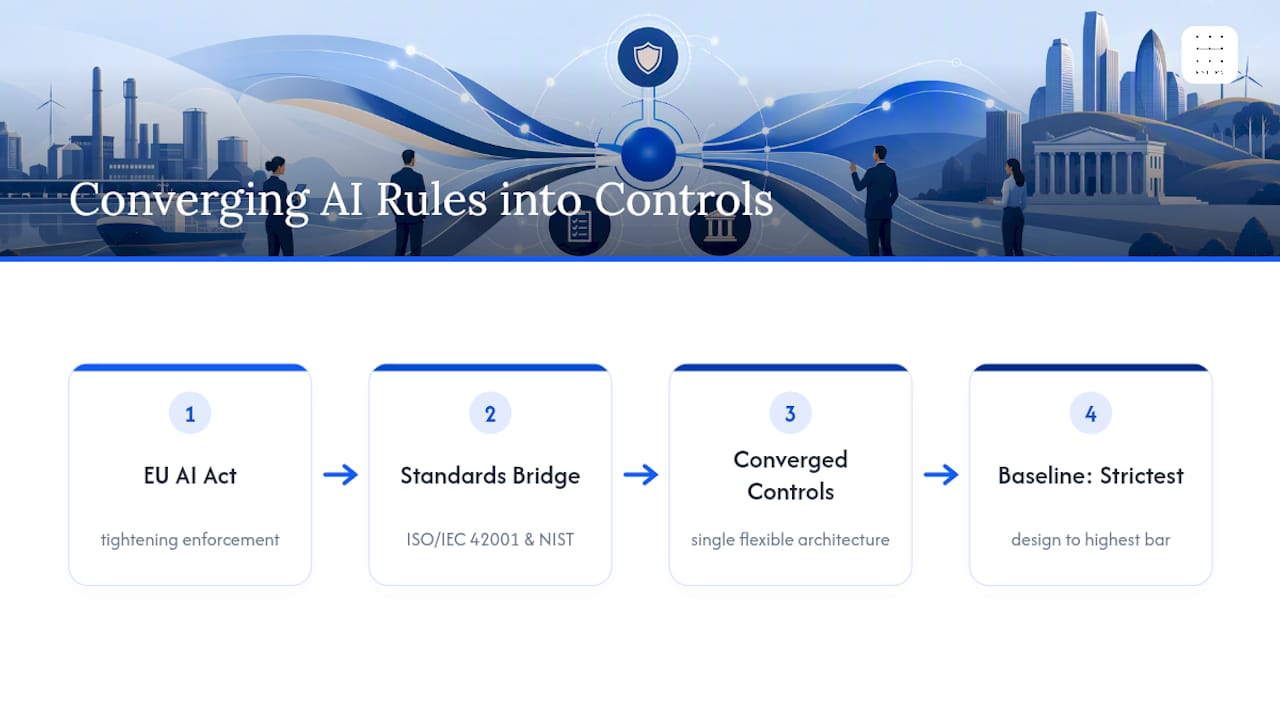
Runtime enforcement is likely to become standard rather than novel. Tools that block a request at inference time and stamp it with a rule reference are currently a differentiator; within a couple of years they will likely be a baseline expectation, the same way encryption in transit went from a selling point to a given. Sector-specific frameworks will keep multiplying too, particularly in pharma, where the FDA and EU positions still do not fully align. Firms that build a flexible evidence architecture now, one that can absorb a new framework without a rebuild, will spend far less adapting to whatever comes next.
Author perspective: three leadership priorities for adopting AI safely
Fund the boring infrastructure first: immutable logs and model lineage, before a single explainability dashboard. Preserve human judgement at every real decision point, not as a checkbox, but as a named person with the authority to override. Treat governance as an operational capability you staff and budget for, not a project that ends when the pilot does.
— Rohit
Book a clarity session or audit with Pattrn Data
Pattrndata starts every engagement by mapping how the work actually happens, not by selling a tool first and worrying about controls later. That ordering is the concrete advantage over rushing straight to a vendor demo: you get a documented view of your real AI exposure, including shadow AI, before you commit budget to anything.

If you need a fast, structured read on where AI already touches regulated decisions in your firm, the AI Clarity Session is built for exactly that, a focused session that maps risk and hands you a practical next-step plan. Firms with more systems in play, or genuine audit pressure ahead of the August 2026 deadlines, typically need an SME or enterprise audit, which produces a full gap list ranked by priority alongside audit-ready evidence you can hand an examiner. Small teams that need a controlled place to turn messy requests into tracked, approved action without data spilling into consumer AI tools should look at Artha.
Book a session, get the gap list, and start the smallest pilot that fits your actual risk. That is the whole method.
Sources
Recommended
Frequently asked questions
What is the 30% rule in AI?
There is no single official “30% rule” recognised by regulators; the phrase is used informally in different contexts, sometimes referring to thresholds for AI-generated content disclosure, sometimes to model accuracy benchmarks. If you encounter it in a specific regulation or vendor claim, check the primary source directly rather than assuming a fixed industry standard.
How is AI regulated in the UK?
The UK currently relies on existing regulators, the FCA, ICO, and sector bodies, applying their existing powers to AI rather than a single dedicated AI statute, while UK GDPR governs automated decision-making and data protection. Firms operating across the UK and EU should note the EU AI Act’s high-risk obligations still apply where systems affect EU markets, so cross-border deployers typically design to the stricter EU standard regardless of where they are based.
Which jobs are least likely to be replaced by AI?
Roles built around judgement under regulatory accountability, senior clinical decisions, complex legal advice, and final sign-off in financial advice, are the hardest to automate because liability and professional judgement remain with a named human. AI tends to support these roles by handling drafting, triage, and data preparation rather than replacing the accountable decision itself.
What was Stephen Hawking’s warning about AI?
Stephen Hawking warned that poorly controlled artificial intelligence could eventually outpace human oversight and pose an existential risk if development outran safety and governance measures. That warning is broader than the operational compliance questions regulated firms face today, but it underlines the same underlying principle this article makes: capability without oversight is the danger, not AI itself.
What does Pattrn Data’s AI Clarity Session actually deliver?
The AI Clarity Session is a one-off session priced at £497 that maps where AI is currently used in your firm, including unsanctioned tools, and gives you a practical next-step plan. It is designed as the entry point before a full audit or governance retainer, not a substitute for one.
Choosing AI tools for your practice?
Book a free 30-minute discovery call to talk through the risks and options with Rohit. Use the deeper service links only when you already know the decision needs audit, governance or implementation support.
AI Risk & Efficiency Audit
Map real workflows, AI use, data exposure, opportunity value and governance controls before buying or building more tools.
book the AI Risk & Efficiency AuditAI governance consulting
Create policies, approval routes, ownership and controls that teams can actually use day to day.
AI governance consultingAI workflow automation
Turn repeatable admin, client service and reporting work into controlled workflows with clear human review points.
AI workflow automation support