
4 Step AI Red Team Pilot for SMEs That Turns Findings Into Tests
Short answer
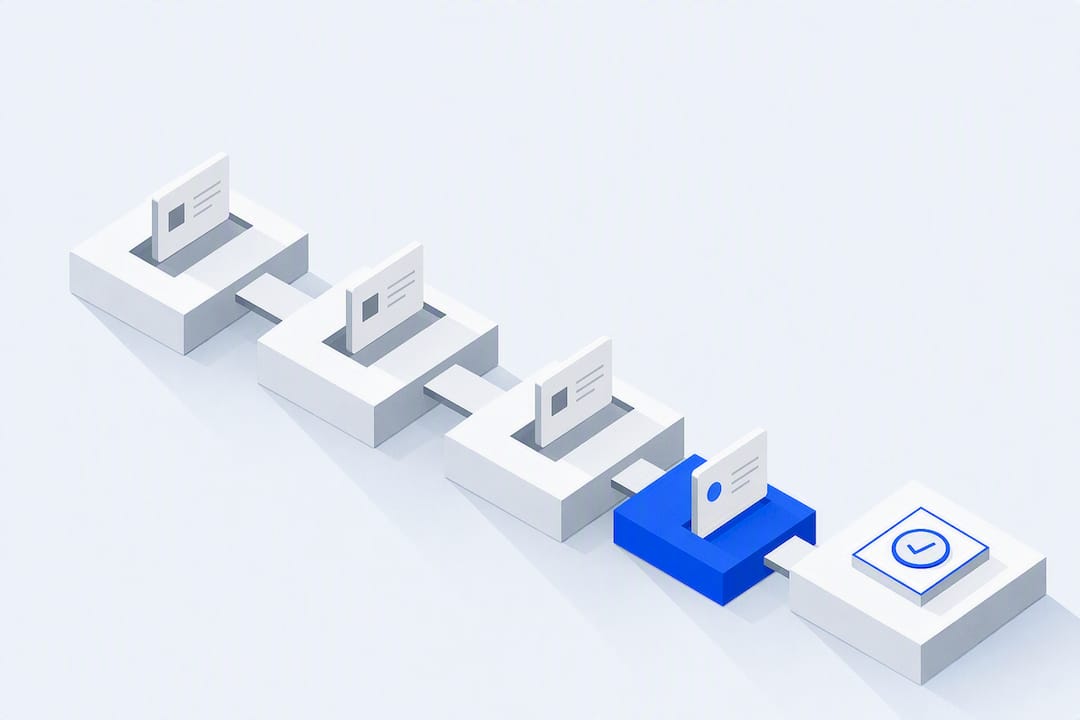
AI red teaming tests how a whole application behaves when inputs are hostile, including retrieved documents and tools it can call. Start with one bounded workflow and an agreed stop rule; log reproducible failures and turn the fixes into repeatable tests.
AI red teaming tests how a whole application behaves when inputs are hostile, including retrieved documents and tools it can call. Start with one bounded workflow and an agreed stop rule; log reproducible failures and turn the fixes into repeatable tests.
TL;DR:
- Scope one application workflow with its prompts, retrieved material and connected-tool permissions. Name the test owner and record exclusions before running the pilot; no attack success rate is assumed.
- Use exploratory testing to identify failures, then automate checks whose inputs and expected results can be specified.
- Choose tests for the business impacts in scope, including indirect prompt injection and disclosure of confidential information where relevant.
- A disciplined process includes scope definition, evidence logging, iterative passes, and converting findings into regression tests for continuous monitoring.
- Record harm categories and test cases in a shared matrix, with an owner responsible for updating it as the workflow changes.
Table of Contents
- What is AI red teaming and how does it differ from benchmarking?
- What are the main attack surfaces in an AI system?
- What testing methods and tactics do red teams actually use?
- How do you plan and run a safe red-team campaign?
- What tools help automate AI red teaming, and where do they fall short?
- What can operators learn from large-scale AI red-team programmes?
- How do you build red-team findings into governance and audit trails?
- Who is behind this guidance, and what does a small pilot look like?
- What actually matters once the testing stops
- How Pattrndata supports a first AI red-team pilot
- Where to read more on AI red teaming
- Sources
What is AI red teaming and how does it differ from benchmarking?
AI red teaming explores how a system responds to adversarial inputs. A benchmark measures performance against a defined test set; a pilot can also investigate failures that set does not cover. The linked account describes how a red team tries to find questions nobody thought to ask. For a pilot, combine exploratory sessions with repeatable checks where the expected behaviour is clear.
Include application security questions in the scope: unpatched software, access controls and authentication still need attention. For the AI workflow, also examine retrieved content and tool authorisation. Write down which boundaries a hostile input might cross, such as a document influencing a decision or a generated instruction reaching an action-capable tool. Choose tests for those paths instead of treating a model chat as the whole application.
Test the actual connections to a CRM, document store or email-capable agent where they are in scope. A direct refusal test does not test what happens when instructions arrive through a retrieved document. Use controlled documents to examine that path, and check whether any resulting tool action stays within its permissions. Do not assume that a clean-chat result covers the connected workflow.
Four things worth holding onto before scoping any test:
- System scope. Decide which prompts, retrieval-augmented generation (RAG) pipelines, tool integrations and downstream actions the pilot will test.
- Exploration and repeatability. Allow room to investigate unfamiliar behaviour, and specify repeatable checks for confirmed failures.
- Testing roles. Manual discovery should come first, with automated tools reinforcing what testers already know to look for.
- Review scope. Revisit the attack paths when the system changes; record what the tests do and do not cover.
Keep conventional application security review in the plan. Decide how the pilot's findings will reach the people responsible for authentication, access control and the code that carries out tool actions.
What are the main attack surfaces in an AI system?
Start with an impact to test, such as a support agent approving an unauthorised refund, then map possible attack paths. The linked Microsoft account discusses red teaming 100 generative AI products. Check which lessons apply to your workflow before adopting a test method or attack library.
Once the impact is clear, map it to the routes an attacker could realistically use to reach it. In most AI applications, that means working through a handful of recurring attack surfaces.
- Direct prompt injection, where an attacker types instructions straight into a chat interface to override the system prompt or safety guidance.
- Indirect prompt injection, where malicious instructions arrive hidden inside a document, webpage, or email that the model retrieves and treats as trusted content. Test whether those instructions can influence an answer or tool action in the workflow under review.
- Data exfiltration, where careful questioning or encoding tricks the model into revealing system prompts, other users’ data, or confidential business records.
- Tool-authorisation abuse, where an agent with the power to send emails, update records, or trigger payments is tricked into using that power outside its intended bounds.
- Memory poisoning, where a system with persistent memory or long-running context is fed false information early, which then quietly shapes later, unrelated interactions.
- Supply-chain manipulation, where a compromised plugin, fine-tuned adapter, or third-party model update introduces a vulnerability nobody in the business chose to accept.
Before applying a result from SafePrompt on prompt-injection testing, check the tested system, attack set and success definition. This article does not establish a success rate for internal tools. Measure results against the pilot's own criteria and record how repeated attempts were counted.
If the firm uses OWASP LLM Top 10 categories, MITRE ATLAS techniques or the NIST AI RMF, assess where each finding belongs in that framework. Record the business impact and remediation owner even when a category is uncertain. Framework mapping does not by itself establish compliance; confirm any audit, insurance or regulatory requirements separately.
What testing methods and tactics do red teams actually use?
One way to organise a pilot is to group tests by known patterns, encoded inputs, multi-turn exchanges and external content. Choose the groups relevant to the workflow and record any gaps. The following structure is a proposal for the pilot, not a verified attribution to Palo Alto Networks.
- Known-pattern testing. Run established jailbreak prompts, role-play framings, and documented injection strings first. Record which known patterns the test set covers and which it leaves out.
- Encoding bypass testing. Wrap the same intent in Base64, leetspeak, unusual Unicode, or a different language, then compare the result with the plain-text version under the same conditions.
- Multi-turn attacks. Test whether a sequence of exchanges can cross a boundary that a single-message check rejects. Capture the conversation and the resulting action or disclosure.
- Indirect injection via external content. Plant instructions inside a PDF, a webpage, or a calendar invite that the system will later retrieve and treat as legitimate input. Use test documents and confirm which retrieved passages reached the model.
Within the chosen test groups, vary language and framing. Candidates include ambiguity or typos, false urgency, claimed authority, imagined scenarios and requests presented as stories or academic exercises. Test combinations when they represent a relevant attack path. Record whether the boundary held; an encoding trick or fictional frame is a test input, not proof that a filter can be bypassed. Check the cited NVIDIA account before adopting its terminology as a taxonomy.
Pro Tip: Agree what stops the pilot and what pauses a particular test group. Fix a confirmed gap before repeating that group, while recording any relevant attack paths that remain untested.
For each finding, capture the input, assembled context, relevant retrieval passages, model configuration and tool traces needed to investigate it. Record attempts and outcomes, including cases that do not reproduce. Set access and retention rules for this evidence so logging does not create another disclosure route. For example, a single success against ten failures differs from nine successes out of ten. Record the denominator and test conditions alongside each result, and use confirmed examples to define regression checks. Those checks cover the tested behaviour, not every possible recurrence.
How do you plan and run a safe red-team campaign?
A red-team campaign needs a written scope before anyone opens a chat window, and that scope should name the impacts being tested for, the systems in bounds, the systems explicitly out of bounds, and who signs off on findings before anything gets escalated. Include an owner and an escalation route so a finding has somewhere to go after testing.
For the chosen system, identify who can answer the security, product and risk questions. The roles below can be combined where a small team has the necessary expertise and authority.
- A security lead or AI red-team owner who scopes the campaign and signs off on severity ratings.
- A model or product owner who understands the intended behaviour well enough to know what “broken” actually looks like.
- One or two testers with genuine adversarial creativity, drawn from security, or from anyone in the business known for finding the edge cases nobody planned for.
- A compliance or risk contact who translates findings into the language a risk register or auditor expects.
Use an isolated test environment with synthetic records for this first pilot. Check that tool calls cannot send real messages, change customer records or incur unapproved charges. Configure evidence capture before testing, with restricted access and a retention period suited to the records. Set request and spending limits, and agree stop conditions, including unexpected access to real customer data. Confirm the isolation rather than relying on a test-environment label.
Once testing produces findings, the workflow from there follows a familiar security shape: triage each finding for severity based on business impact rather than technical novelty, assign an owner for remediation, fix the underlying gap (a system prompt change, a stricter tool-authorisation rule, a retrieval filter), and then write a regression test that reruns the exact successful attack against the patched system. A passing regression check shows the patched system met that test's criteria under the recorded conditions. Repeat relevant checks after model, prompt or permission changes, and investigate failures before release. Firms uncertain about what should happen when an AI tool misbehaves in production can work through Pattrndata’s guidance on handling AI tool failures as a starting template for that escalation path.
What tools help automate AI red teaming, and where do they fall short?
Choose automation for tests whose inputs, boundaries and expected results can be specified. Assess proposed methods in the Adrian blog. If considering PyRIT, check the actual version, supported target connections and scoring options before using it in a pilot. Keep a reviewer responsible for interpreting results, especially where harm cannot be represented by a simple pass/fail condition. A tool's output still needs to be connected to the application's permissions and business impact.
Separate pre-release test tools from production monitoring when comparing options. For a scanner, inspect the attack library and supported targets. For an interactive playground, check whether inputs and results can be captured and replayed. For runtime monitoring, decide which events it can observe and how an alert reaches an owner. Verify those features for the selected product; none establishes complete coverage or detection of every change.
For confirmed failures, define regression tests and decide which failed checks should block a release. Run them against the candidate configuration and retain the results with its version. Revisit the suite when the workflow changes; a passing pipeline only covers the checks it ran and does not make the boundary permanent.
Check whether the threat model matches actual use, whether the attack library covers the paths in scope, and whether retrieval and tool actions have tests of their own. Record uncovered paths in the report instead of treating the tool's default suite as exhaustive.
Include the connected tools and their actual permissions in the agent pilot. Test allowed, denied and unexpected actions, and record the boundary and gaps. Confirm the scope of the related service separately rather than claiming its review coverage: Pattrndata’s work on secure agent development
What can operators learn from large-scale AI red-team programmes?
Read the linked Microsoft account before transferring a large programme's methods to a small pilot. Compare its targets and success criteria with your system. For the pilot, record the original result and repeat relevant tests after a mitigation, under comparable conditions. That comparison can inform the remediation decision without establishing that the fix covers every attack path.
The following records can help organise a small pilot; assign responsibility for maintaining them.
- A threat-model ontology, a shared, written taxonomy of harm categories and attack techniques so different testers describe the same failure the same way.
- A living test matrix, mapping attack surfaces to specific test cases, expected evidence, and pass/fail criteria, updated as new failure modes get discovered.
- Consistent severity scoring, so a data-exfiltration finding from one sprint and one from six months later get compared on the same scale.
- Evidence retention, setting access and retention rules for the inputs, outputs and traces needed to investigate findings and explain decisions.
Two hypothetical tests illustrate the workflow; they are not verified client cases. In a customer-service pilot, place a fabricated discount instruction in a synthetic PDF and check whether the assistant repeats it or changes a ticket. If the boundary fails, review how retrieved content reaches the decision and whether the action is separately authorised. Replay the document after any change. In an HR pilot, use synthetic salary records and test whether a sequence of questions reveals information outside the test user's access. Compare the whole conversation with the access policy. Record the observed result before claiming that a content or permission control has fixed it.
How do you build red-team findings into governance and audit trails?
Link each reproduced red-team finding to the tested input, configuration, observed effect, owner and remediation. Retest the corrected workflow and record coverage limits; a passed model-only test is not evidence about every retrieval or tool path.
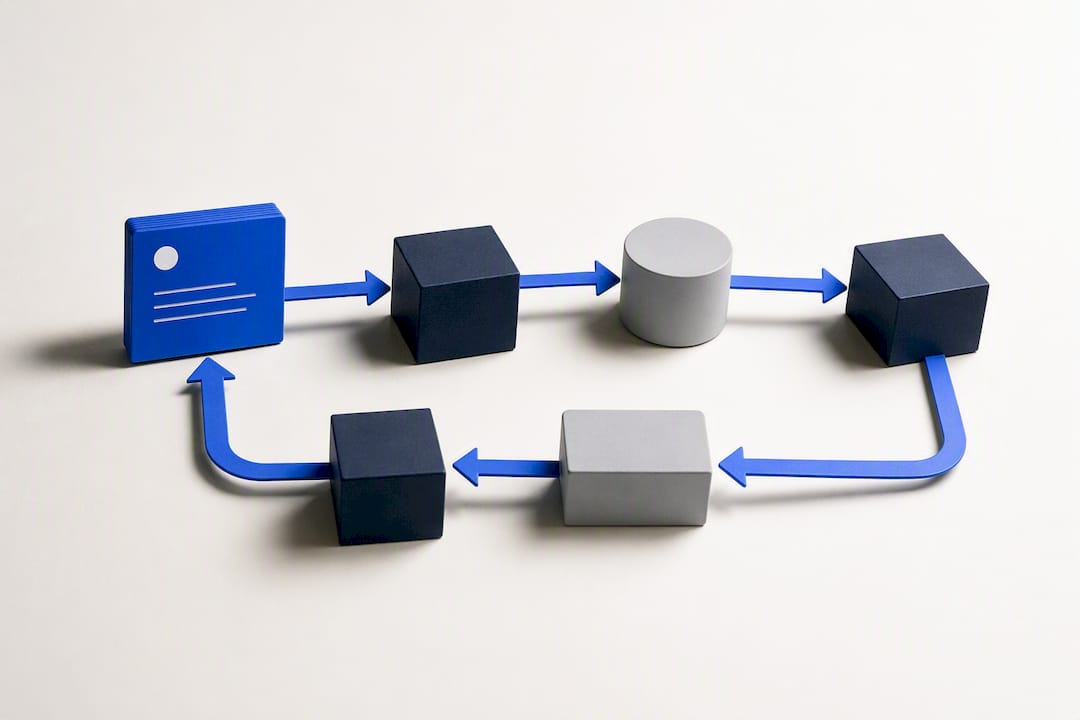
Set re-test triggers for model, prompt and permission changes. Link the original finding, mitigation and test result to the configuration tested, and decide which failures block release. Confirm separately what evidence a client, auditor or regulator requires. Firms working through what an AI-assisted audit trail should actually contain can use Pattrndata’s guidance on building audit trails without spreadsheets as a practical checklist for that documentation layer.
Name the person responsible for the pilot and its follow-up. That may be a security lead, a responsible-AI lead or an operational risk owner in a smaller firm. Confirm that they can assign remediation work and arrange re-testing, rather than only receive the report. The table below is a proposed allocation to adapt to the team.
| Governance element | What it needs to contain | Who typically owns it |
|---|---|---|
| Risk register entry | Finding, severity, impact, owner, remediation date | Security lead or risk owner |
| Regression test | Exact input, expected pass criteria, CI gate | AI/ML engineering |
| Re-test schedule | Trigger events (model update, prompt change), cadence | Security or governance function |
| Audit evidence | Inputs, outputs, tool traces, version history | Compliance or responsible-AI lead |
Who is behind this guidance, and what does a small pilot look like?
This article is by Rohit for Pattrndata. For a professional services firm or operations-heavy SME considering a pilot, map the workflow and its data boundaries before choosing the tests. If using a Pattrn Protocol checklist, confirm its actual content and how it applies to that workflow; a framework name does not establish the coverage of an assessment.
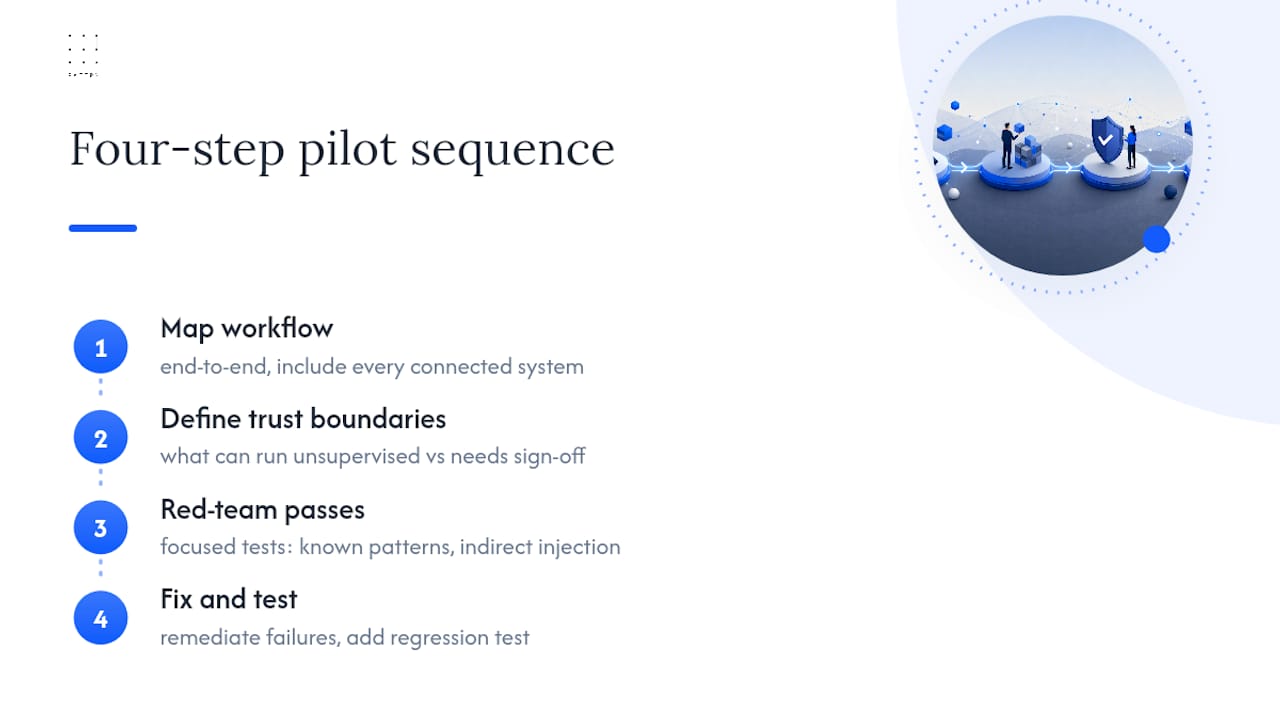
For a first pilot, propose four steps on one workflow and agree the people, time and spending required for that scope.
First, map a single workflow end to end, including every system it touches: the model, any retrieval source, any tool it can call. Second, define the trust boundaries explicitly, what the system is allowed to do unsupervised and what always needs a human sign-off. Third, run a focused set of red-team passes against that one workflow, starting with known patterns and working through indirect injection if retrieval is involved. Fourth, fix whatever breaks and write a regression test for it before calling the pilot done.
If the firm does not yet know which AI tools or Copilot connections are in use, define the inventory questions before commissioning an AI risk and readiness assessment. Confirm the deliverables, price and whether it examines the attack paths relevant to the proposed pilot.
What actually matters once the testing stops
After testing, check that each finding has a severity decision and an owner, with a mitigation or an explicit decision about the remaining risk. Link the relevant regression or manual test and set a follow-up date. The report should also identify untested paths so a completed pilot is not mistaken for complete system coverage.
Prioritise findings using their business impact, exposure and observed behaviour. A retrieval failure that reaches a real permission boundary needs a different response from an isolated prompt result. Review what the current tests miss before purchasing another tool, and confirm who will maintain any added tests or monitoring.
Rohit
How Pattrndata supports a first AI red-team pilot
If considering Pattrndata for a first pilot, ask for a written scope covering the workflow inventory, retrieval sources, tool permissions and handling of findings. Agree which tests and follow-up work are included, who owns remediation and what remains outside the engagement. Confirm the assessment's actual deliverables rather than assuming it is a fixed-scope red-team review.

Use the findings to decide whether remediation requires a secure AI implementation project for tool authorisation or data boundaries, or whether maintaining the risk register and re-tests calls for an AI governance retainer. Confirm the scope of either service, including responsibility for re-testing after model and prompt changes. Start with a bounded workflow whose test results the firm can review before expanding the programme.
Where to read more on AI red teaming
The sources behind this guide are worth reading directly if you’re building a programme rather than just scoping one pilot.
- Lessons From Red Teaming 100 Generative AI Products (Microsoft): a reading subject for comparing a large programme with the pilot; verify any borrowed method against the paper.
- What Is AI Red Teaming? (Palo Alto Networks): check the original account before attributing a four-pass method to this publisher.
- Defining LLM Red Teaming (NVIDIA): check the source's definitions and whether its taxonomy suits the workflow being tested.
- LLM Red Teaming: Test Plan, Examples & OWASP Map (Phixe): check any examples and framework mappings before incorporating them into a test matrix.
- How to Test Your AI App for Prompt Injection Vulnerabilities (SafePrompt): check the tested targets and criteria before transferring any results to a release check.
- What Does AI Red-Teaming Actually Mean? (CSET Georgetown): compare its account of exploratory and automated testing with the pilot's scope.
Sources
Recommended
Related services
AI governance consulting
Create policies, approval routes, ownership and controls that teams can actually use day to day.
AI governance consultingAI workflow automation
Turn repeatable admin, client service and reporting work into controlled workflows with clear human review points.
AI workflow automation supportAI Risk & Efficiency Audit
Map real workflows, AI use, data exposure, opportunity value and governance controls before buying or building more tools.
book the AI Risk & Efficiency Audit