
Audit Trail Reporting: 5 Steps to Audit Ready Evidence for Compliance

Short answer
A quick answer first, then the fuller context below.
Practical guide for compliance and professional firms to scope, generate, and automate audit trail reporting. Map workflows, keep human review, and...
Audit trail reporting is the practice of generating structured, time-stamped records of who did what, when, and how, across your systems, so you can prove control integrity to auditors and investigate incidents when something goes wrong. Frameworks including SOC 2, ISO 27001, and HIPAA all treat this as a baseline expectation, not an optional extra. Done properly, it turns scattered log data into evidence you can hand to a regulator, an auditor, or your own board with confidence.
TL;DR:
- Properly scoped and filtered reports, focusing on relevant actions and timeframes, ensure efficient investigation and compliance without overwhelming data.
- Including key fields such as access method, IP address, and MFA status helps distinguish between routine activity, automated scripts, and potential security incidents.
- Regularly validating data integrity with hashes and confirming retention policies aligns with regulatory requirements builds trust in audit trail evidence.
- Automating data collection through scheduled queries and dashboards reduces manual effort and improves consistency in detecting anomalies.
- Mapping workflows before logging ensures audit trails directly support the questions auditors will ask, avoiding gaps and irrelevant noise in reports.
Table of Contents
- What audit trail reporting covers: definition, scope and use cases
- Key fields and components every audit trail report must capture
- How to generate and scope an audit trail report in practice
- How to interpret audit trail reports: from columns to decisions
- Automating audit log analysis and building an analysis pipeline
- Retention, integrity and chain-of-custody for audit trail reporting
- Common pitfalls, noise handling and troubleshooting audit reports
- Pattrn Data perspective: mapping workflows before tools
- How Pattrn Data can help with audit-ready workflows
- Sources
- FAQ
What audit trail reporting covers: definition, scope and use cases
An audit trail report is a structured, tamper-evident record of system activity that captures who performed an action, what changed, and when it happened. Forensic Notes describes this as essential fields including date/time, actor, object type, action, and access method, and that framing holds whether you are tracking a general ledger entry, a permissions change, or an API call.
The scope varies by context. In finance, an audit trail might show a journal entry moving from draft to posted, with the user ID and timestamp attached at each stage. In security operations, it might show a failed login followed by a successful one from a different IP address. In software delivery, it might show a configuration change to a production environment.
Different roles depend on this data for different reasons:
- Finance and controllership teams need it to evidence segregation of duties and reconcile entries.
- Compliance officers need it to demonstrate that controls operated as designed.
- Security teams need it to reconstruct incidents and identify lateral movement.
- Internal and external auditors need it as primary evidence during fieldwork.
Key fields and components every audit trail report must capture
A report missing the right fields is close to useless once an auditor starts asking follow-up questions. The non-negotiable core is timestamp, actor (user ID), object or resource affected, the action taken, and the method used to perform it.
Pro Tip: If you can only fix one gap this quarter, fix missing access-method data. Knowing whether an action came through a browser, an API call, or an automated script is often the single fact that separates a routine change from a security incident.
Beyond the core fields, stronger reports include:
- Correlation or request IDs, so related events across systems can be joined into one timeline
- Before-and-after values (a diff), particularly for financial or configuration changes
- IP address and userAgent, which help distinguish human activity from scripted or automated activity
- Document or ticket references, linking the system event back to an approval or change request
- MFA authentication status, flagging whether the session was properly verified
Field selection should follow your purpose. A financial audit trail leans on document numbers, debit and credit amounts, and reversal links, the kind of detail Microsoft’s Business Central Audit Trail report provides at the G/L entry level. A security investigation leans harder on IP, userAgent, and authentication status. Building both into your logging from the start avoids re-engineering later.
How to generate and scope an audit trail report in practice
Most failed audit trail reports fail before a single row is pulled, because the scope was never defined. Get the scope right and the rest is mechanical.
- Define the object and time window first. Decide whether you’re reporting on a single account, a business unit, or a whole system, and pick a window tight enough to be useful (a quarter, not three years).
- Select the action types that matter. Creates, updates, deletes, and access events each answer different questions. Don’t default to pulling everything.
- Apply filters for user, IP, event type, and correlation ID. This is what turns a data dump into a readable narrative rather than a spreadsheet nobody will open.
- Choose your export format deliberately. CSV suits further analysis, JSON suits API-to-API transfer, PDF suits a signed-off evidence pack for an auditor.
- Set up scheduled exports for recurring needs. If you produce the same evidence pack every quarter, automate the pull rather than rebuilding the query from memory each time.
Pro Tip: Avoid the temptation to export “everything, just in case.” Oversized exports slow down review, bury the signal an auditor actually needs, and increase the risk of exposing data that should have stayed out of the evidence pack.
How to interpret audit trail reports: from columns to decisions
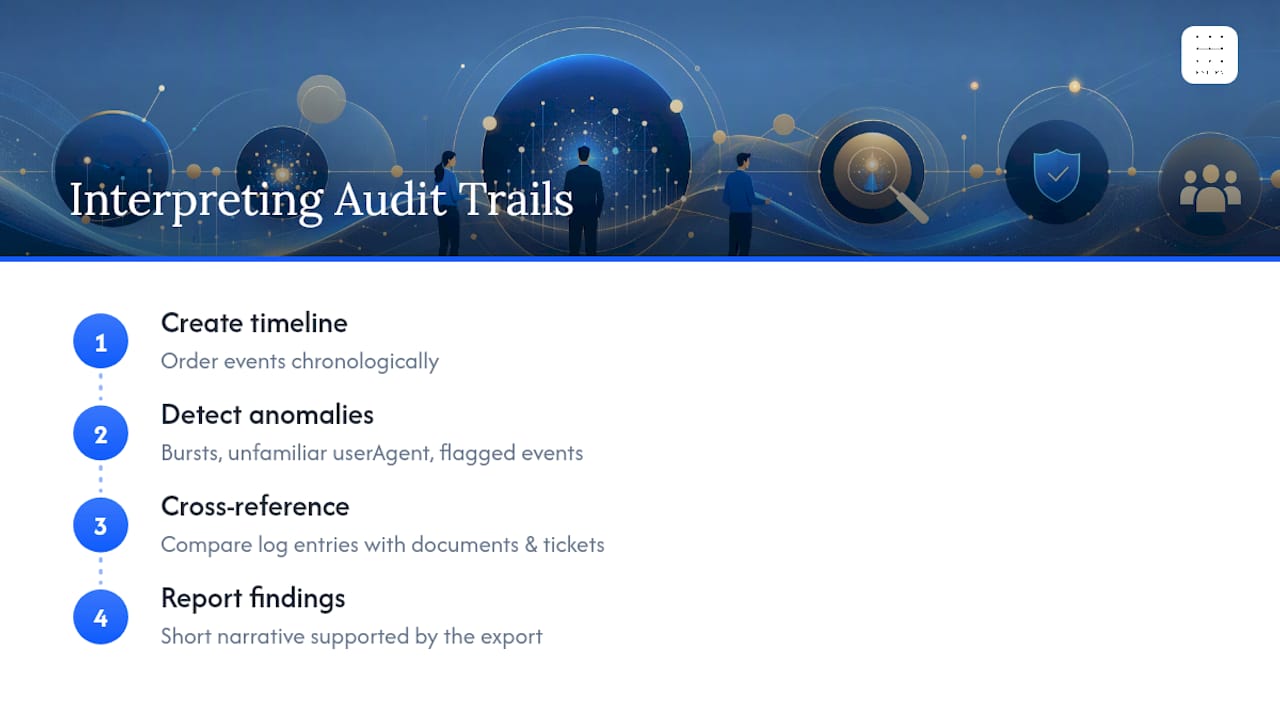
Rows of timestamps mean nothing until you turn them into a timeline. Order events chronologically and look for what breaks the normal pattern: a burst of activity outside business hours, an unfamiliar userAgent string, or an event flagged with mfaAuthenticated: false where verified access should have been mandatory.
Google Cloud’s guidance on log analysis points to exactly this kind of anomaly detection, using baseline queries and statistical thresholds to flag unusual behaviour such as spikes in API requests or changes to retention settings. AWS’s incident response guidance goes further, noting that fields like userAgent, session names, and timing patterns often reveal staged or automated attacks that a human operator would never produce.
Cross-reference the log entries against source documents and ticketing systems wherever possible, using security tooling and best practice to help identify anomalies and verify user activity. An approved change request should have a matching timestamp and user ID in the audit trail; if it doesn’t, that gap is itself a finding.
Auditors generally validate four things: completeness (no gaps in the sequence), non-repudiation (the actor cannot credibly deny the action), preserved originals (nothing was altered after the fact), and proper handling of reversals or corrections. Package your findings as a short narrative supported by the underlying export, not just a raw table.
Automating audit log analysis and building an analysis pipeline
Manually pulling reports works until log volume outgrows human review, which happens faster than most teams expect. The fix is a pipeline, not a bigger spreadsheet.
High-fidelity security events, logins, permission changes, financial postings, belong in an active, searchable store. Low-value noise, health checks, heartbeats, routine polling, should route straight to cheap cold storage, a pattern Confluent’s guidance on real-time compliance logging recommends specifically to keep active analysis fast and affordable.
SQL-style tools such as BigQuery or Google’s Log Analytics let teams run scheduled queries that baseline normal behaviour and flag deviations automatically, including pre-built queries for detecting anomalies like unusually high API usage by a single principal. Dashboards then give auditors and operations staff drill-down access without needing to write a query themselves.
| Pipeline stage | Typical approach | Main trade-off |
|---|---|---|
| Ingestion and routing | Split high-fidelity events from noise at source | Requires upfront classification effort |
| Storage | Active index for recent/critical data, cold storage for the rest | Cost savings versus slower retrieval on old data |
| Analysis | Scheduled SQL queries, statistical baselining | Detection quality depends on tuned thresholds |
| Presentation | Permissioned dashboards over static exports | Better self-service, more access control to manage |
Retention, integrity and chain-of-custody for audit trail reporting
A report an auditor cannot trust back to its source is not evidence, it’s a claim. Retention policy is the starting point: map how long you keep logs to what your regulator or contract actually requires, not to whatever your storage vendor defaults to.
Integrity controls matter just as much as retention length. Cryptographic hashing at the point of export, paired with a versioned evidence store, gives mathematical proof that an exported file matches the original log, which closes off any argument that the evidence was altered after the fact.
Pro Tip: Hash your evidence exports the moment they’re created, not when you package them for the auditor weeks later. A hash generated after the fact proves nothing about what happened in between.
Before sharing an evidence pack, confirm:
- Retention period matches your regulatory or contractual obligation
- Export was hashed and the hash is stored alongside the file
- Access to the export required approval, not just any team member’s login
- Segregation of duties held: the person who made the change isn’t the one certifying the evidence
Common pitfalls, noise handling and troubleshooting audit reports
Most audit trail problems trace back to noise, not malice. Fix the noise and the signal usually takes care of itself.
- Route heartbeat and health-check events out of your active analysis store; they inflate volume without adding evidentiary value.
- Watch for inconsistent timestamps across systems (time zone mismatches are a common, boring cause of “missing” events).
- Cap export sizes and use sampling when data volumes are genuinely too large for a single pull, rather than letting a report time out mid-generation.
- Validate row counts and date ranges against the request before sending anything to an auditor, a five-minute check that prevents a much longer follow-up conversation.
Pattrn Data perspective: mapping workflows before tools
Most audit trail failures aren’t technical. They happen because nobody mapped the workflow before choosing what to log, so the report exists but doesn’t answer the question an auditor actually asks. The Pattrn Protocol starts from the opposite direction: map how the work happens, decide what evidence that workflow needs to produce, then build the logging around it.
The smallest useful pilot is narrow: pick one workflow, produce one evidence pack, and confirm a human still signs off before anything leaves the building. That’s how you find the gaps before a regulator does, and it’s a far more useful test than trying to fix audit trails across every system at once. Our guidance on creating audit trails for AI-assisted workflows walks through this at pilot scale.
— Rohit
How Pattrn Data can help with audit-ready workflows
Building an evidence-grade pipeline from scratch, hashing, routing, retention policy, dashboards, takes real engineering time most professional services firms don’t have spare. That’s the gap Pattrn Data works in: AI clarity sessions and risk and efficiency audits that map your actual workflow before recommending a single tool, followed by Copilot workflow design, data integration, and reporting builds where they’re genuinely needed.

There are private workspace and business operating system solutions designed to keep approvals, evidence, and human review intact rather than letting automation quietly take over judgement calls. If you’re deciding whether to build this in-house or bring in a partner, the honest answer depends on whether you have spare engineering capacity and someone accountable for governance. If you don’t, that’s exactly where we help.
Start with our guide on creating audit trails for AI-assisted workflows without spreadsheets to see what a controlled pilot looks like before you commit to a bigger build.
Sources
Recommended
Frequently asked questions
What is an audit trail report?
It’s a structured, time-stamped record showing who performed an action, what was changed, and how, typically capturing fields like actor, object, action, and access method.
What is an example of an audit trail?
A finance example is Microsoft Business Central’s Audit Trail report, which shows G/L entries with posting date, user ID, document number, and reversal links.
How do I report audit trail findings in an audit report?
Present a chronological narrative backed by the underlying export, addressing completeness, non-repudiation, and how any reversals or corrections were handled.
How do I run an audit trail report?
Define the object and time window, filter by user, IP, and event type, then export as CSV, JSON, or PDF depending on whether the data feeds further analysis or a signed-off evidence pack.
What’s the difference between an audit trail and audit trail reporting?
The audit trail is the raw underlying log of events; audit trail reporting is the process of scoping, filtering, and presenting that log as usable evidence for compliance or investigation.
Choosing AI tools for your practice?
Book a free 30-minute discovery call to talk through the risks and options with Rohit. Use the deeper service links only when you already know the decision needs audit, governance or implementation support.
AI governance consulting
Create policies, approval routes, ownership and controls that teams can actually use day to day.
AI governance consultingAI workflow automation
Turn repeatable admin, client service and reporting work into controlled workflows with clear human review points.
AI workflow automation supportAI Risk & Efficiency Audit
Map real workflows, AI use, data exposure, opportunity value and governance controls before buying or building more tools.
book the AI Risk & Efficiency Audit