
Evidence First Copilot Studio Use Cases for Professional Services
Short answer
A quick answer first, then the fuller context below.
Governance first Copilot Studio guidance for professional services: evidence‑first agent patterns, a 4 step pilot checklist, and KPIs to prove value.
Copilot Studio is a low-code platform for building AI agents that automate bounded, repeatable business work: triaging support tickets, chasing invoice queries, onboarding new starters, or summarising a client meeting into follow-up actions. Done properly, the payoff is time saved, faster follow-up, cleaner routing of tasks to the right person, and an audit trail of what the agent actually did. This article covers the concrete use cases, how to implement one without creating a governance headache, and how to measure whether it worked.
TL;DR:
- Copilot Studio is effective for bounded tasks like invoice matching, ticket triage, and meeting follow-up, where inputs, outputs, and escalation paths are clear.
- Implementation requires mapping workflows thoroughly, choosing low-risk pilots, and involving IT, security, and compliance teams early to avoid governance issues.
- Capacity and quota limits, connector dependencies, and data governance are critical constraints that must be modeled before deployment.
- Measuring success involves establishing baselines and KPIs, such as handling time reduction and ticket deflection, and tracking these metrics within operational dashboards.
- Adoption relies on staff training that clarifies agent boundaries, trust-building through real case demonstrations, and ongoing feedback loops during the pilot phase.
Table of Contents
- Copilot studio use cases across business functions
- How to implement Copilot Studio: a governance-first sequence
- Limitations, quotas and governance you need to plan for
- Measuring value: blueprints, KPIs and baselines
- Run your first pilot: a short checklist
- Connecting Copilot Studio beyond the Microsoft ecosystem
- Getting staff to actually use the agent
- What is next for Copilot Studio and where the roadmap points
- Pattrn Data’s take on safe Copilot Studio adoption
- How Pattrn Data helps you pilot Copilot Studio safely
- Sources worth reading next
- FAQ
Copilot studio use cases across business functions
Most organisations picture Copilot Studio as a customer-facing chatbot. That undersells it. Microsoft’s own architecture guidance points to a much wider set of reference architectures and solution ideas spanning customer service, IT, HR, finance and document workflows, and the pattern that matters for professional services is narrower and more useful than a generic chatbot: an agent that gathers evidence, checks it against approved sources, and routes gaps to a named human.
Here is where Copilot Studio earns its keep in practice.
-
Customer service triage and self-service. An agent answers routine account questions from approved knowledge sources and creates a support ticket automatically when it cannot resolve the query, tagging priority and category before a human ever sees it.
-
IT helpdesk intake and first-tier diagnostics. Password resets, access requests and common software faults get resolved or logged without a ticket sitting in a queue overnight. The agent asks the right diagnostic questions first, so the engineer who picks it up starts with useful context instead of “it’s broken.”
-
HR onboarding and policy Q&A. New starters ask about leave policy, benefits enrolment or IT setup at 9pm without waiting for an HR inbox reply the next morning. The agent handles the repetitive questions; a person still signs off contracts and sensitive decisions.
-
Finance workflows: invoice matching and anomaly triage. Copilot Studio can flag mismatched purchase orders, surface duplicate invoices, and draft reconciliation notes for a finance controller to review. Microsoft’s own examples show code-interpreter tooling auditing transactions and generating annotated reports. This is a genuinely useful pattern for finance teams drowning in spreadsheet reconciliation.
-
Document and meeting follow-up. An agent summarises a client call, extracts action items, drafts a follow-up email for review, and routes tasks to the named owner. This is one of the highest-value patterns for advisers and consultants who lose hours to post-meeting admin.
-
Field service and sales enablement. Engineers look up parts availability or installation guidance on-site; sales teams get personalised product recommendations pulled from approved catalogues rather than memory.
-
Legal and contract operations. An agent checks a contract against a clause library, flags deviations from standard wording, and routes anything outside tolerance to a named reviewer rather than approving anything itself.
-
Evidence-and-follow-up agents for document-heavy teams. This is the pattern professional services firms should pay closest attention to: an agent that pulls from approved sources only, identifies where evidence is missing or contradictory, and assigns the gap to a specific reviewer with a deadline, rather than attempting to close the gap itself. Pattrn Data’s Medical Survey Copilot case study is a working example of this pattern in a regulated context, where the agent’s job was to gather and flag, not to decide.
What ties these together is scope discipline. Every one of the above works because the task is bounded, the inputs are known, and the escalation path to a human is explicit — not because the underlying model is clever.
How to implement Copilot Studio: a governance-first sequence
Skipping straight to “build the bot” is the single most common way pilots go wrong. Microsoft’s own getting-started guidance and its governance Q&A both point the same direction: map the workflow before you touch the tool.
- Map the workflow and decision points. Write down every step a human currently takes, including the ones nobody bothers to document because “everyone just knows.”
- Choose a narrow, high-volume, low-risk pilot. The best first agent is rarely the most ambitious one. Pick a task where inputs and outputs are explicit, and where a mistake is annoying rather than damaging.
- Identify approved knowledge sources and permissions. Decide exactly which documents, databases or connectors the agent can read, and who owns that list.
- Classify data residency and retention needs before a single agent touches client or patient data.
- Define actions, permissions, escalation rules and audit requirements. Every action the agent can take needs an accountable owner and a record of what happened.
- Build and test in a development environment, using representative inputs and deliberately adversarial cases designed to break the agent.
- Pilot with human review in place, publish to the relevant channel, then monitor quality, cost and how often the agent escalates.
Pro Tip: The failures that sink pilots almost never show up in the demo. Test grounding (does the agent answer outside its approved sources?), connector authentication (does access silently expire?), and hand-off (does an escalated case actually reach a human, with context, every time?) before you let real users near it.
Firms that want an outside check on where the biggest risks sit before building often start with a structured AI clarity session rather than guessing.
Limitations, quotas and governance you need to plan for
Copilot Studio has real production constraints, and they surface at the worst possible moment: after launch, under real traffic. A community analysis of production limits notes that customer-facing or autonomous agents making many downstream API and flow calls can hit rate limits fast, so capacity and session constraints need modelling before go-live, not after.
Plan around these constraints specifically:
- Subscription, environment and throughput quotas that cap how many requests an agent can process, particularly at peak traffic.
- Connector and licence dependencies. An agent is only as reliable as the systems it reads from, and every connector adds an authentication point that can silently fail.
- Hand-off constraints. There are two primary patterns for connecting an agent to a live human: fronting an engagement hub, or running bot-in-the-loop alongside a human agent. Each carries different trade-offs around control and complexity, as Microsoft’s channel guidance sets out.
- Full transaction cost, not just chat volume. Retries, connector calls, downstream API costs and human escalation time all belong in the capacity plan, not just the headline message count.
On governance specifically, Copilot Studio supports data residency, DLP, customer-managed keys, Microsoft Entra ID authentication and Agent 365 controls, and these need configuring before an agent is published, not retrofitted after a near-miss. Involve IT, security and compliance from the start rather than after the pilot is already live.
Measuring value: blueprints, KPIs and baselines
Microsoft publishes agent business-value use-case blueprints that pair a specific business question with the KPIs, baseline method and value drivers needed to answer it. That structure matters because “the agent saves time” is not a measurement, it is a hope.
Capture a baseline before launch: current handling time, current escalation rate, current backlog age. Then track the same metrics post-pilot using an Agent Assisted Hours-style formula, comparing time spent per case before and after.
| Use case | Baseline metric | Target KPI |
|---|---|---|
| Invoice triage | Manual matching time per invoice | Reduction in average handling time |
| Knowledge deflection | Tickets requiring human reply | Percentage deflected to self-service |
| HR onboarding | Days to resolve policy queries | Reduction in first-response time |
Feed these metrics into existing dashboards and audit logs rather than a standalone spreadsheet, so agent performance sits alongside the rest of operational reporting instead of living in isolation.
Run your first pilot: a short checklist
- Pick a task with high volume, low risk, and clear inputs and outputs.
- Assign a domain owner, IT, security, compliance and a named reviewer.
- Run representative and adversarial test cases against a fixed timeline.
- Set stop/go criteria, then iterate, widen scope, or pause and fix governance gaps.
Connecting Copilot Studio beyond the Microsoft ecosystem
Most real deployments need to reach systems that were never built for AI agents: a practice management platform, a CRM, an accounting package, or an industry-specific case management tool. Copilot Studio connects to these largely through Power Platform connectors and custom connectors built against a system’s own API, which means the integration is only as reliable as that API’s documentation and rate limits.
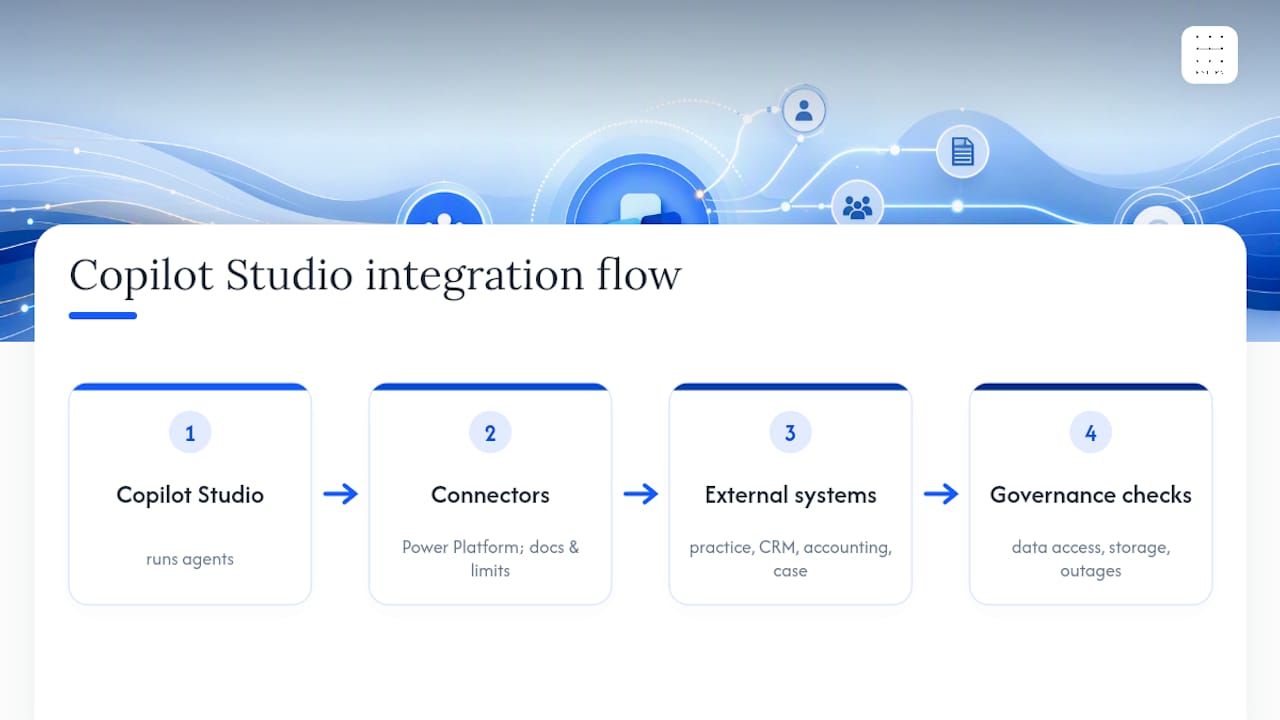
For document-heavy teams, this is where enrichment matters most. An agent handling client onboarding, for instance, might need to pull company data, verify identity records, or check market information from outside Microsoft’s ecosystem entirely. Tools like Prowl, which connects agents to a wide range of market-intelligence sources through a single protocol, illustrate the broader pattern: rather than building bespoke connectors for every data source an agent might need, firms are increasingly routing through aggregated connector layers that handle authentication and data formatting once.
The trade-off is control. A third-party connector you did not build is a dependency you did not fully vet, so the same governance questions apply: what data does it see, where is it stored, and what happens if the connector goes down mid-transaction. Test third-party integrations with the same adversarial rigour as internal connectors, and document exactly which external systems an agent can reach before it goes live.
Getting staff to actually use the agent
An agent nobody uses is a wasted pilot, and adoption failures are rarely about the technology. They are about staff not trusting the output, not knowing when to escalate, or not understanding what the agent is actually for.
Start training with the boundary, not the feature list: tell staff exactly what the agent will handle, what it will not, and where a human decision still applies. Run a short live session where the team watches the agent handle real (anonymised) cases from the pilot, including one it gets wrong, so people see the escalation path working rather than trusting a perfect demo.
Give staff a simple way to flag a bad response, and actually review those flags weekly during the pilot. Adoption drops fast when people report a problem and nothing visibly changes. Build in a short feedback loop from day one, tied to the same reviewer who owns escalations, so training and governance reinforce each other rather than running as separate exercises.
What is next for Copilot Studio and where the roadmap points
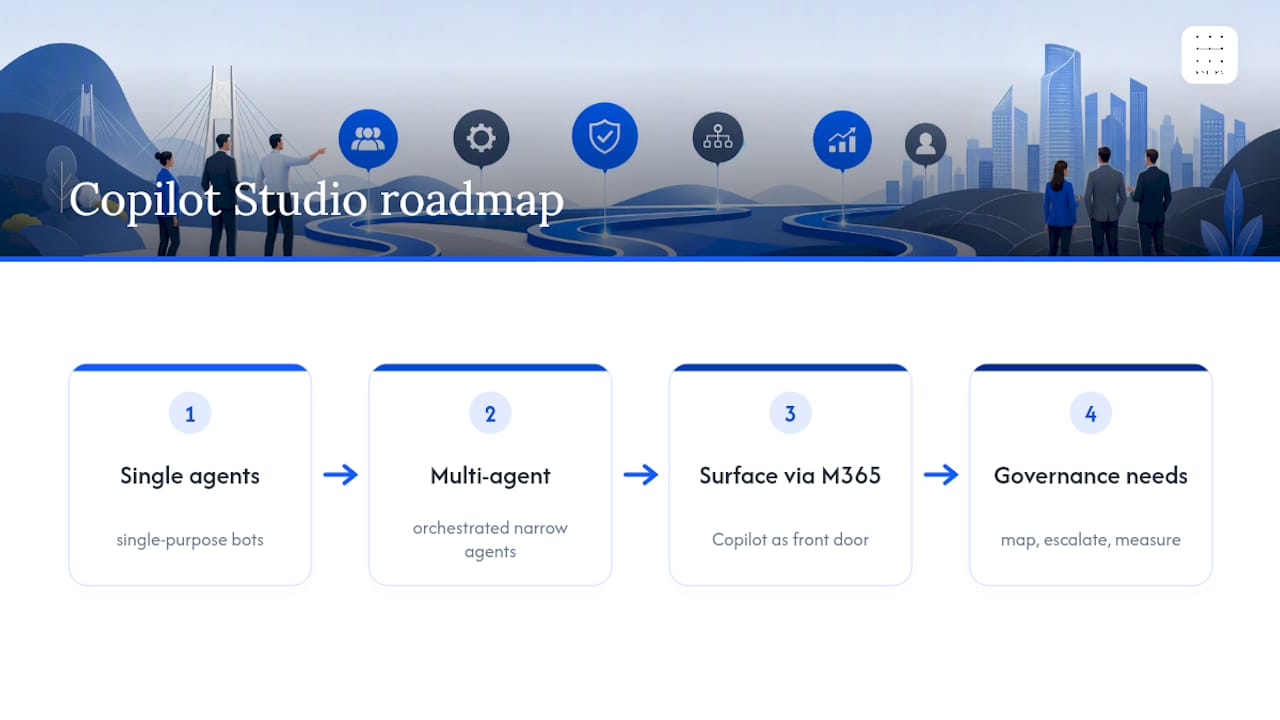
Copilot Studio is moving from single-purpose bots toward multi-agent orchestration, where several narrow agents each handle a specific step and hand off to one another, coordinated through frameworks like Agent 365. That shift raises the stakes on governance rather than lowering them: more agents means more hand-off points, more permission boundaries to define, and more places where an audit trail can quietly go missing if nobody planned for it.
Expect tighter integration with Microsoft 365 Copilot as the front door for most business users, meaning agents built in Copilot Studio increasingly surface inside tools staff already use rather than as a separate destination. For professional services firms, the practical implication is straightforward: the platform will keep getting more capable, but the discipline of mapping a workflow, defining escalation, and measuring against a baseline does not become optional as the tooling matures. If anything, it becomes more important, because a more capable agent given a badly scoped task fails in more expensive ways.
Pattrn Data’s take on safe Copilot Studio adoption
Every project we scope starts with mapping the actual workflow, not the tool. The Medical Survey Copilot case study worked because the agent gathered and flagged evidence; it never decided anything. Start smaller than feels ambitious, and instrument it properly, because you cannot fix what you never measured.
— Rohit
How Pattrn Data helps you pilot Copilot Studio safely
We help firms adopt Copilot Studio by mapping workflows first, then building narrow agents fitting those workflows, with human review and audit trails integrated rather than added later.

Our work in this space runs from a fixed-scope AI Clarity Session to scope a safe first pilot, through to a Microsoft Copilot Clarity Session focused specifically on Copilot Studio workflow design, and full AI agent development for firms ready to build. If you are unsure where the risk actually sits before committing budget, our SME and enterprise audits give you a clear-eyed view of what to automate and what to leave alone. Start with one narrow, measurable pilot rather than an enterprise-wide rollout: book an AI Clarity Session and bring one workflow to the table.
Sources worth reading next
For the technical foundations, Microsoft’s own Copilot Studio fundamentals page and its agent business-value blueprints are the two most useful starting points. For governance grounded in a real deployment, Pattrn Data’s case studies and its guidance on ethics and review rules for automating client work cover the accountability questions Microsoft’s documentation does not.
Recommended
Frequently asked questions
What are the benefits of using Copilot Studio?
The main benefits are time saved on repetitive tasks, faster follow-up on documents and client queries, and cleaner routing of work to the right person with a record of what happened. The gains show up fastest on bounded tasks like ticket triage, invoice checks or meeting follow-up, not open-ended work.
What are good use cases for Copilot?
The strongest use cases are narrow and repeatable: customer service triage, IT helpdesk intake, HR onboarding Q&A, invoice matching, and evidence-gathering agents that flag gaps to a named reviewer. Microsoft’s own reference architectures list similar patterns across customer service, finance and document workflows.
What are the limitations of Copilot Studio?
Copilot Studio has throughput and quota limits that can be hit by high-volume or heavily-connected agents, and it depends entirely on clean, permissioned data and reliable connectors. It also cannot make judgement calls safely on its own; hand-off to a human reviewer needs to be designed into the workflow from the start, as Microsoft’s security and governance guidance makes clear.
How much does it cost to get help implementing Copilot Studio?
Pattrn Data’s AI Clarity Session is £497 one-off and scopes a safe first pilot; audits and full implementation projects are priced individually and listed on the pricing page .
Where should a firm start if it has never used Copilot Studio?
Start with one narrow, high-volume, low-risk task where the inputs and outputs are already clear, such as invoice matching or meeting follow-up. Map the workflow, assign a named reviewer for escalations, and test with adversarial cases before any real users touch it.
Choosing AI tools for your practice?
Book a free 30-minute discovery call to talk through the risks and options with Rohit. Use the deeper service links only when you already know the decision needs audit, governance or implementation support.
AI workflow automation
Turn repeatable admin, client service and reporting work into controlled workflows with clear human review points.
AI workflow automation supportAI governance consulting
Create policies, approval routes, ownership and controls that teams can actually use day to day.
AI governance consultingAI agents for professional services
Scope, test and govern AI agents for internal knowledge, client service and operational support.
governed AI agents for professional services