
Governance First Document Workflow Automation for Professional Firms
Short answer
A quick answer first, then the fuller context below.
Governance first document workflow automation for professional firms and SMEs. Map processes, keep human review, and create audit ready workflows before...
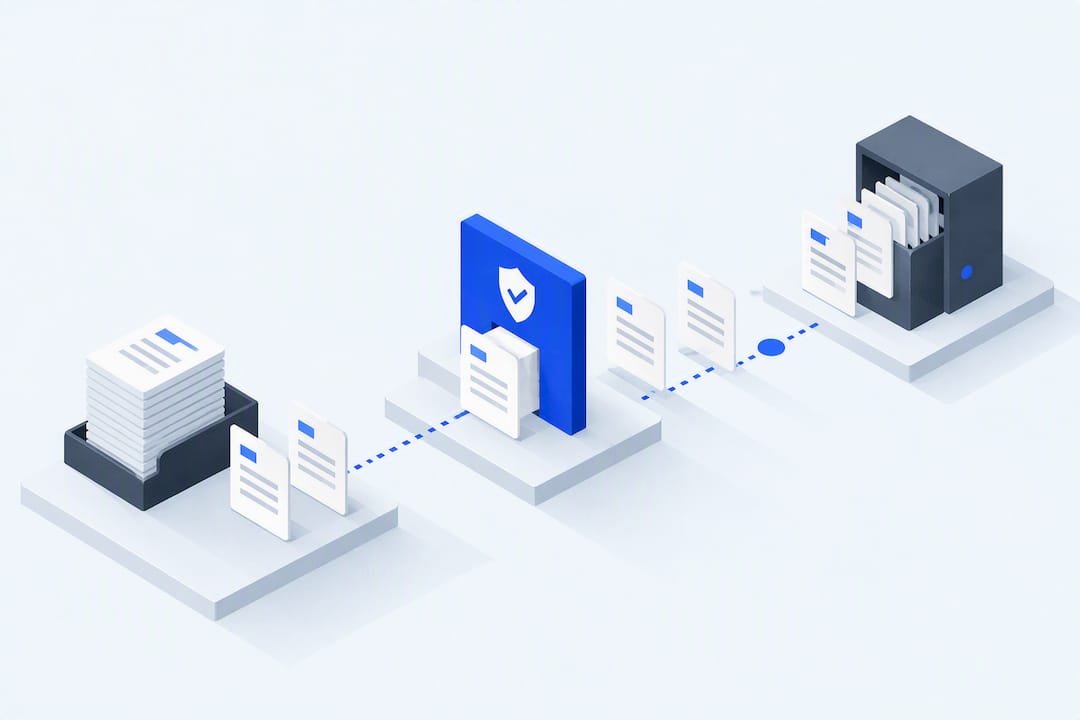
Document workflow automation routes a document through creation, review, approval and storage without manual chasing, so the final version always has a clear owner, a recorded decision and an audit trail. Firms that automate this properly cut cycle times, remove the version-control chaos of email attachments and give compliance teams evidence they can actually retrieve. It suits professional services firms, growing SMEs and any compliance-heavy team drowning in PDFs and approval chains.
TL;DR:
- Automating document workflows yields significant gains in speed, accuracy, consistency, and compliance, but requires careful mapping of existing processes first.
- High-volume workflows with clear decision rules, low political sensitivity, and well-defined ownership are best for pilots, such as client onboarding or invoice approval.
- Successful automation depends on designing exception handling, SLA triggers, and using tools that support durable audit logs and system integration.
- Mapping the actual workflow, setting KPIs, and running a small pilot before scaling is essential to avoid missed exceptions and unintended errors.
- Launching with a governance-first plan, including role-based access, version control, and clear retention policies, ensures trustworthy and compliant automation.
Table of Contents
- What is document workflow automation and how does it work?
- Why automate document workflows: what’s the actual payoff?
- What are good examples of document workflow automation?
- How do you build a document workflow automation pilot?
- What governance rules keep document automation safe?
- How Pattrn Data approaches document workflow automation
- When is automation the wrong first move?
- Get a clear, governance-first automation plan from Pattrn Data
- Sources
- FAQ
What is document workflow automation and how does it work?
Document workflow automation replaces manual routing, chasing and filing with a defined path a document follows automatically from creation to archive. The mechanics matter more than the label: get the structure wrong and you have simply moved your email chaos into a new interface.
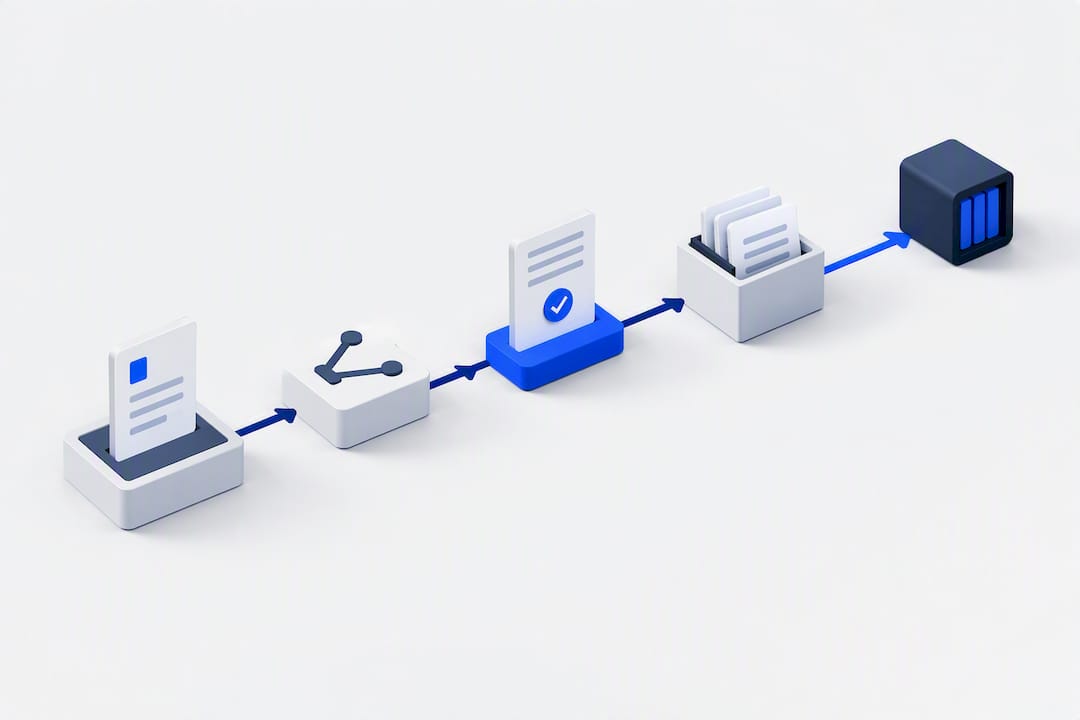
Every workflow needs five components. An intake or trigger starts the process, whether that’s a client uploading a file, a new contract being drafted, or an invoice landing in a shared inbox. A routing engine then decides who sees the document next. Reviewer actions capture approvals, rejections or comments. A signature or evidence step records the final decision, and a storage and audit trail locks the approved version with a permanent record of who did what, and when.
Routing typically follows one of three patterns:
- Sequential — one reviewer must finish before the next sees the document (useful for hierarchical sign-off, like a junior adviser then a partner).
- Parallel — several reviewers act at the same time, and the workflow waits for all responses before moving on.
- Conditional — the route changes based on rules, such as an invoice above a set amount automatically escalating to a second approver.
Automation itself usually sits across a document management system, a workflow or business process engine, e-signature software, intake forms and, increasingly, OCR for extracting data from scanned files. A typical flow: a client uploads a contract draft, the system validates the file type and required fields, routes it sequentially through legal and finance, captures an e-signature, then archives the signed version with its approval history intact, exactly the creation-to-storage arc described in Box’s guide to document workflow automation.
Why automate document workflows: what’s the actual payoff?
The case for automation rests on five measurable gains: speed, accuracy, consistency, compliance and visibility. Speed comes from removing the gaps where a document sits in someone’s inbox waiting to be noticed. Accuracy improves because routing rules and validation checks catch missing fields before a human ever has to. Consistency means every contract, invoice or policy follows the same review path regardless of who submitted it. Compliance and visibility follow naturally once every action is logged rather than buried in an email thread.
None of that is worth pursuing without a way to measure it. Set KPIs before the pilot starts, not after:
- Cycle time — total time from submission to final approval.
- Time-to-approval — how long a document waits at each review stage.
- Exception rate — the percentage of documents that hit an unplanned path or require manual intervention.
- Percentage automated — the share of the workflow completing without human routing.
- SLA compliance — how often approvals land within agreed deadlines.
Industry signal: Gartner forecasts that 30% of enterprises will automate more than half of their network activities by 2026, a marker of how far automation is moving from a back-office experiment into a standard operating assumption.
AIIM’s research on information management adoption also flags a common barrier worth naming early: firms often automate the easy 80% of a process and leave the exceptions unresolved, which quietly drags the whole KPI set back down.
What are good examples of document workflow automation?
Some workflows make far better pilots than others. The best candidates share high volume, clear rules and low political sensitivity, so you can prove value before touching anything genuinely high-risk.
-
Client onboarding and document collection. The trigger is a new client signing up; the workflow validates uploads in real time, flags missing or malformed files, and can run initial format or fraud checks before a document ever reaches a human reviewer, an approach Inscribe’s automated collection research shows measurably reduces follow-up emails and correction cycles. The owner is usually operations; the pitfall is skipping validation and simply digitising a slow manual chase.
-
Contract and procurement approvals. Routing here is almost always conditional: contract value, counterparty risk or department determines who signs off. Signature capture closes the loop, and the approved contract archives alongside its approval record. The common mistake is letting legal review happen outside the workflow, in email, which breaks the audit trail the moment anyone asks for evidence.
-
HR onboarding and policy distribution. New starter packs typically need sequential review (manager, then HR) but parallel acknowledgement (all staff confirming they’ve read an updated policy). The owner is HR; the pitfall is forgetting re-approval triggers when a policy changes, leaving staff who signed the old version technically uncovered.
-
Invoice approvals and purchase requests. Amount-based conditional routing is the standard pattern: a £500 invoice might need one sign-off, a £50,000 one needs three. Exception handling matters most here, because disputed invoices need a defined path back to the requester rather than silently stalling.
-
Policy updates and regulated documentation. Version control is the whole game. Every update needs a re-approval trigger so the “current” version is never ambiguous, particularly for firms working under FCA or other regulatory oversight where an outdated policy in circulation is itself a finding.
How do you build a document workflow automation pilot?
Map before you build. Choosing software before understanding the process is the single most common reason automation projects stall or get quietly abandoned six months in.
-
Map the existing process end to end. Identify every actor, every decision point, every exception, where documents enter the process, and what evidence each step actually requires. Do this on paper or a whiteboard before opening any software.
-
Choose a high-impact, low-complexity pilot. Practical guidance on automation pilots consistently points to the same principle: pick the highest-volume, highest-friction workflow with the simplest decision rules. It proves value fast and meets less resistance than a workflow tangled in edge cases.
-
Design routing rules, SLAs, escalation paths and re-approval triggers. Decide who approves what, how long each stage has before it escalates, and precisely when a document needs a fresh round of sign-off, such as after a material edit.
-
Select tooling that fits your existing stack. Favour tools that support durable state and audit logging over ones that simply look modern. If your current systems (practice management, CRM, document store) already talk to each other, a minimal automation layer often beats a full platform replacement.
-
Test with real documents. Run the pilot in parallel with the existing manual process for a defined period, collect the KPIs set out earlier, gather feedback from the people actually using it, then iterate before scaling to a second workflow.
Pro Tip: Design exception handling before you design the happy path. Guidance on reliable, human-in-the-loop document approvals stresses that a workflow must persist its state across long waits, such as a client taking a week to sign, and through system restarts, so nothing resets or vanishes. Without that durability, one stalled approval sends the whole process back to email, and the audit trail you built the pilot to create disappears with it.
What governance rules keep document automation safe?
Automation without governance just creates faster mistakes. A handful of rules separate a resilient workflow from one that quietly erodes trust the first time something goes wrong.
- One owner, one controlled draft. Every document needs a single named owner and one version treated as the master copy; naming conventions and locking the final approved file prevent the classic “which version is current” problem.
- Role-based access controls. Reviewers see only what their role requires, exports are restricted, and sensitive documents are encrypted both in transit and at rest.
- A defined retention policy. Know how long each document type is kept and why, particularly where regulatory retention periods apply.
- Durable workflow state. The system must resume exactly where it left off after a long wait or an outage, rather than losing context or forcing a restart, a point Temporal’s guidance on reliable approvals makes directly.
- Explicit exception handling. Decide in advance whether a rejection returns to the requester, closes the request outright, or forces a fresh submission, and keep human review firmly in place for high-risk decisions.
- Logging and monitoring. Track stalled approvals actively; a document sitting untouched for a week is a signal worth flagging automatically, not discovering by accident.
Cogniver’s guidance on approval workflows recommends archiving the final approved file together with its approval summary as one immutable bundle, so a compliance check never involves hunting across three systems for evidence that should sit in one place.
How Pattrn Data approaches document workflow automation
Pattrn Data runs every automation project through the same discipline: map the real workflow first, set clear data boundaries, pilot with a human still making the final call, then govern what’s built so it stays trustworthy under audit. That order rarely gets reversed, because skipping the mapping stage is where most automation projects go wrong before they even start.
The Medical Survey Copilot Agent case study shows this in practice: a document-heavy survey process was automated for speed while human reviewers stayed responsible for every judgement call, with each decision logged so the process remained fully auditable rather than a black box.
A clarity session or audit typically leaves a client with:
- A mapped version of the actual workflow, exceptions included, not the idealised version everyone assumes happens.
- A risk checklist covering data boundaries, access controls and where human review needs to sit.
- A defined pilot scope with realistic KPIs, ready to test before anything is scaled.
When is automation the wrong first move?
Automation solves a mapped problem faster. It cannot fix an unmapped one. If there’s no clear document owner, no single controlled version, exceptions outnumber the “normal” path, or nobody has agreed what success looks like, automating now just moves the same confusion into a faster machine.
The fix is unglamorous: map the process, connect the data sitting in disconnected systems, and run a small pilot on a low-risk task before touching anything near a client decision or a regulatory judgement. Stage it deliberately. Automate the routing and reminders first; keep a person making the calls that carry real consequence. Judgement doesn’t get automated. Everything around it, the chasing, filing and reminding, can be.
— Rohit
Get a clear, governance-first automation plan from Pattrn Data
Pattrndata is the alternative to guessing your way through a software purchase: instead of buying a platform and hoping it fits, you start with a mapped workflow, a named pilot, and a risk checklist before anything gets built.

That starts with an AI Clarity Session, a focused session that maps your document workflow, flags where exceptions and data risks sit, and scopes a pilot with real KPIs attached. For firms with document-heavy regulated processes already showing strain, an SME Audit or Established Business Audit (priced on the pricing page) goes deeper, covering the full risk and efficiency picture before any automation build begins. Teams wanting Copilot specifically applied to document routing can start with the Microsoft Copilot Clarity Session. Book the clarity session first; it’s the cheapest way to find out exactly what should, and shouldn’t, be automated.
Sources
Recommended
Frequently asked questions
What is the best software for documenting workflows?
There’s no single “best” tool; the right choice depends on whether your priority is e-signature, intake validation, or routing logic across existing systems. The better question is whether the tool supports durable workflow state and audit logging, since that determines whether approvals survive long waits and restarts, as Temporal’s guidance sets out. A clarity session can map that requirement before you buy anything.
What is the best way to document a workflow?
Map the process end to end first: every actor, decision point, exception and piece of evidence required at each stage. us/blog/document-approval-workflow" rel="nofollow noopener noreferrer" target=" blank">Practical implementation guides recommend writing this out visually before selecting routing rules or tooling, since a workflow diagram built after the software is chosen almost always misses real exceptions.
What are examples of workflow automation?
Common examples include client onboarding and document collection, contract and procurement approvals, HR onboarding and policy distribution, invoice approvals with amount-based routing, and policy updates requiring version control and re-approval triggers. Each follows the same underlying pattern: intake, routing, review, evidence capture and storage, as described in Box’s overview of document workflow automation.
How do you automate a workflow?
Start by mapping the existing process, then pick a high-volume, low-complexity workflow as your pilot, design routing rules and escalation paths, test with real documents run in parallel with the manual process, and only scale once the metrics hold up. Pattrn Data’s AI automation consulting follows this exact sequence for document-heavy professional services workflows.
How much does document workflow automation cost to implement?
Costs vary widely depending on scope, from a scoped clarity session through to a full audit and build. Pattrn Data’s AI Clarity Session is £497, while a full SME Audit or automation build is priced on the pricing page once the scope is known.
Choosing AI tools for your practice?
Book a free 30-minute discovery call to talk through the risks and options with Rohit. Use the deeper service links only when you already know the decision needs audit, governance or implementation support.
AI governance consulting
Create policies, approval routes, ownership and controls that teams can actually use day to day.
AI governance consultingAI workflow automation
Turn repeatable admin, client service and reporting work into controlled workflows with clear human review points.
AI workflow automation supportAI agents for professional services
Scope, test and govern AI agents for internal knowledge, client service and operational support.
governed AI agents for professional services