
Run Your First Pilot in Weeks: Human in the Loop for Advisers & SMEs

Short answer
Human-in-the-loop design gives a named reviewer a real chance to check and override an AI output before a consequential action. Place that checkpoint where the risk warrants it and record what the reviewer actually checked.
Human-in-the-loop design gives a named reviewer a real chance to check and override an AI output before a consequential action. Place that checkpoint where the risk warrants it and record what the reviewer actually checked.
TL;DR:
- Human review should be reserved for high-risk outputs like regulatory filings, financial transactions, and sensitive client data, with sign-off required each time.
- Risk-tiering based on data sensitivity, impact, regulatory consequences, and model uncertainty determines whether review is manual or automated, with high-risk cases needing real-time approval.
- The most effective workflows use hybrid or synchronous gating for irreversible actions and asynchronous or parallel review for reversible, lower-risk outputs.
- Governance relies on routing work to qualified reviewers, setting clear SLAs, and recording decisions with timestamps and rationales to withstand audits.
- Starting with a narrow, well-mapped pilot focusing on medium-risk, high-frequency tasks prevents costly retrofitting and clarifies where review gates are most needed.
Table of Contents
- What ‘human in the loop’ means for professional services teams
- When to require human review: a risk‑tiering approach
- Design patterns for human-in-the-loop workflows
- Operational controls that make review defensible
- A short implementation checklist: pilot to scale
- Integration and tooling notes for professional services
- Pattrn Data perspective: keeping humans in charge
- Get help mapping your first human-in-the-loop pilot
- Sources
What ‘human in the loop’ means for professional services teams
For advisers, accountants and legal firms, human in the loop is a specific, narrow thing: a mandatory approval step embedded in a live workflow, sitting between an AI-generated output and the action that output triggers. A drafted client letter waits for sign-off before sending. A suggested tax treatment waits for a qualified reviewer before filing. A payment instruction waits for authorisation before it executes.
This article focuses on review and intervention in operational workflows. Define who checks an output, what evidence they receive and when they can stop or override an action. Assess any training or evaluation activity separately instead of assigning it to a business type by default.
Identify who is responsible for the action and what authority the reviewer has to stop or change it. Check the professional, contractual and regulatory requirements for the actual use; an approval step alone does not settle liability.
When to require human review: a risk‑tiering approach
Not every AI output deserves the same scrutiny. Reviewing a low-stakes draft with the same rigour as a six-figure client instruction wastes reviewer time and breeds the kind of approval fatigue that makes people rubber-stamp everything. MAS guidance recommends tiering AI use cases by risk materiality and applying oversight proportionate to that risk, rather than a single blanket rule.
Consider these four dimensions when assessing the review needed:
- Data sensitivity: does the output touch personal data, health information or commercially confidential material?
- Monetary or contractual impact: could the action move funds, bind the firm, or amend a contract?
- Regulatory consequence: could an error have reporting or compliance implications that need assessment?
- Model uncertainty: what evidence is available about the reliability of this output, and how novel is the situation?
Set routing rules for the actual use rather than assigning a review level from the document name alone. For consequential actions, define who reviews before release and what evidence they need. Use sampling only where the assessed consequences and applicable requirements allow it; record that decision.
Design patterns for human-in-the-loop workflows
The following patterns describe different places to put review. Choose according to the action, consequences and opportunity to correct an error.
- Synchronous gate: pause the relevant action until an authorised reviewer approves it. Test that a rejected or unanswered request cannot release that action.
- Asynchronous escalation: route flagged cases to a monitored queue. Define what may continue while a case waits and which actions must remain paused.
- Parallel feedback: review alongside a task that is allowed to proceed. Use this only after assessing whether an error can be detected and corrected before unacceptable harm.
- Hybrid: combine patterns within a workflow, for example a gate before release and a separate review of preparation. Assess each step rather than assuming all upstream work can proceed unchecked.
The trade-offs are real. Synchronous gates add latency and can frustrate clients expecting instant turnaround. Parallel feedback risks a bad output slipping through before correction. Asynchronous queues, left unmonitored, quietly become a backlog nobody owns. Deep architectural guidance suggests deciding gate placement early, because retrofitting rollback logic onto a workflow that shipped without it is expensive and disruptive later.
Pro Tip: Mark irreversible actions and examine the consequences of reversible ones too. A later correction may not undo disclosure or reliance on an incorrect output. Define the gate for the actual risk.
Operational controls that make review defensible
Specify reviewer authority, routing, response times and the record of the decision. Test whether a reviewer can find the evidence, challenge the output and stop the action. A recorded approval does not by itself establish an adequate review.
Routing should follow skill, not availability. A junior administrator shouldn’t approve a complex tax position just because they’re next in the queue; build routing rules that account for expertise and reviewer capacity limits, so nobody is rubber-stamping forty items an hour.
Service levels need teeth. Define an SLA class for each risk tier, set an explicit timeout, and decide in advance what happens when nobody responds. Silent failure, where a request simply sits unactioned, is worse than no automation at all.
- Log every decision with a timestamp, reviewer identity and rationale, not just an approve/reject flag.
- Use idempotency keys where supported, and test how retries, key expiry and downstream handling affect duplicate actions.
- Verify webhook signatures on anything that pushes a decision back into a downstream system.
Consider approval workflow tuning alongside evidence about the cases and decisions reviewed. An approval rate alone does not show whether reviewers scrutinised the work. Review NIST’s AI RMF for relevant risk-management considerations, checking their applicability to the use.
A short implementation checklist: pilot to scale
Start with a bounded pilot and define which failure modes it needs to test. Record what remains untested before considering wider use.
- Map the workflow end to end and mark every irreversible step. This single exercise usually reveals more risk than any tooling discussion.
- Choose one or two pilot use cases, ideally medium-risk, high-frequency work where mistakes are recoverable but annoying.
- Define routing rules, named reviewer roles, SLA timeouts and a rollback playbook before the pilot goes live, not after something breaks.
- Run the AI in shadow mode first, generating outputs that a human reviews without the system acting on them, to calibrate expectations.
- Measure reviewer agreement and turnaround time alongside missed errors, escalations and unresolved cases. Review those results against the pilot criteria before widening scope.
OECD guidance on responsible AI reinforces that this can’t be a one-off setup exercise. Governance needs a named senior owner and a recurring review cycle, not a policy document filed away after launch.
Integration and tooling notes for professional services
Test long waits and restarts in the selected workflow system. Check that pending approvals, timers and decision records recover as intended. Confirm the actual Temporal or other tool configuration rather than assuming an engine choice guarantees an intact audit trail.
For day-to-day integration, Microsoft’s guidance on human-in-the-loop patterns shows review requests pushed straight into Teams via Power Automate or Logic Apps, so reviewers approve or reject without leaving the tool they already work in daily. Treat review in a familiar tool as a design option to test: check whether reviewers can find the evidence, respond and escalate a request, and identify any training they still need.
Show the reviewer the proposed action, relevant evidence and flagged risks, with access to underlying records where needed. Test whether the presentation supports a meaningful check rather than hiding context to make the request shorter.
Pattrn Data perspective: keeping humans in charge
Define review ownership, response expectations and records when designing the workflow. Include a route for delayed, disputed or rejected decisions so that the team can test how oversight works in practice.
A well-crafted protocol exists because mapping the workflow always comes before choosing a tool. Consulting services can run AI clarity sessions and risk audits that identify exactly where approval gates belong, then build workflows, custom agents and governance structures around those decision points, not around whatever the software vendor assumed. If your firm is weighing where to place its first gate, a short scoping conversation may be more useful than another vendor demo.
* Rohit
Get help mapping your first human-in-the-loop pilot
If you’ve read this far and you’re thinking about your own client deliverables, filings or payment approvals, the next useful step is mapping the actual workflow rather than picking a tool first. Pattrn Data’s AI implementation service does exactly that: it identifies where irreversible actions sit, defines review points around them, and builds a pilot plan you can run in weeks, not months.

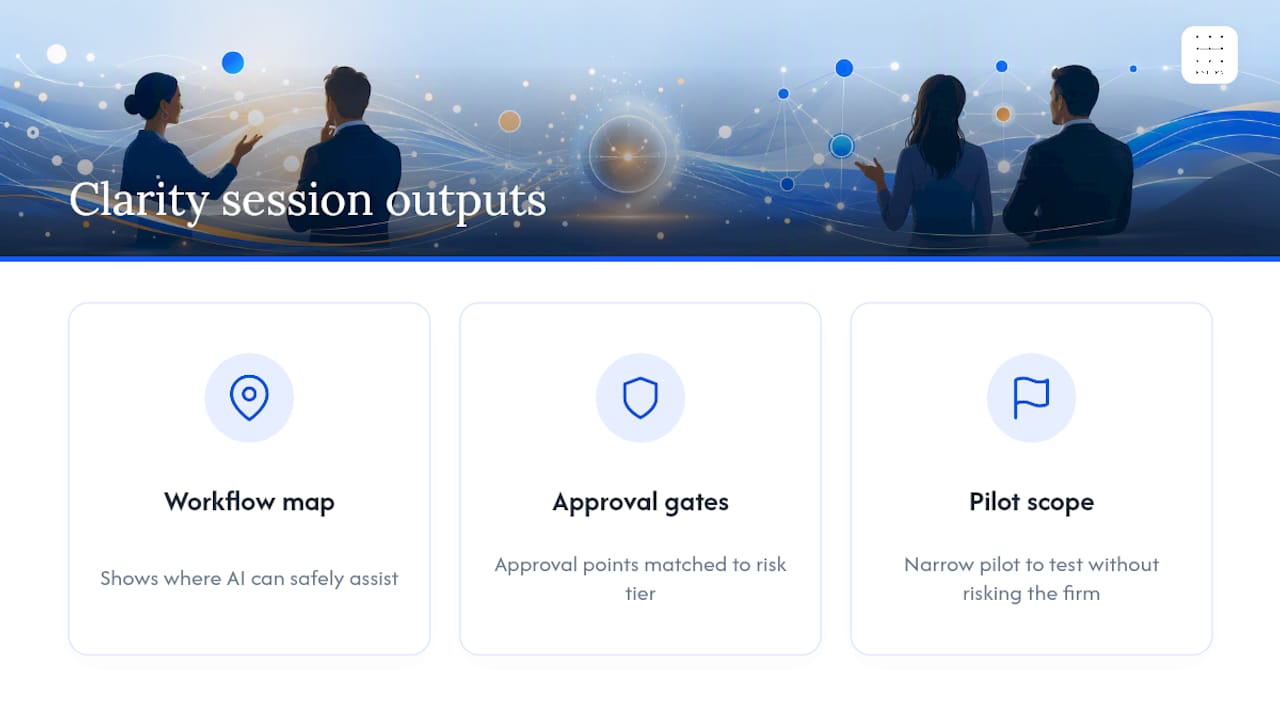
A clarity session or risk audit typically produces several concrete outputs: a workflow map showing where AI can safely assist, a defined set of approval gates matched to risk tier, and a pilot scope narrow enough to test without risking the whole firm. The Medical Survey Copilot case study shows this approach applied to a real agent-based workflow with review built in from the start. Firms with client-facing automation already running should also look at how to connect AI governance across existing systems, and teams exploring adjacent client-facing automation may find the partner guide on AI sales enablement a useful companion read.
Book an AI clarity session or a risk and efficiency audit to get your first pilot scoped properly.
Sources
The NIST AI Risk Management Framework sets out the GOVERN, MAP, MEASURE and MANAGE lifecycle that underpins most serious TEVV practice, while the OECD’s due diligence guidance covers ongoing stakeholder engagement and governance accountability.
For financial services specifically, the MAS executive handbook offers concrete risk-tiering examples. On the implementation side, Microsoft’s Foundry guidance and Temporal’s durable approval patterns are the most useful technical references for building review gates that actually hold up in production.
Recommended
Related services
AI governance consulting
Create policies, approval routes, ownership and controls that teams can actually use day to day.
AI governance consultingAI Risk & Efficiency Audit
Map real workflows, AI use, data exposure, opportunity value and governance controls before buying or building more tools.
book the AI Risk & Efficiency AuditSecure AI implementation
Put privacy, supplier review, data boundaries, testing and staff guidance into the implementation plan from the start.
secure AI implementation