
5 KPIs Lenders Must Track in Mortgage Document Automation Pilots
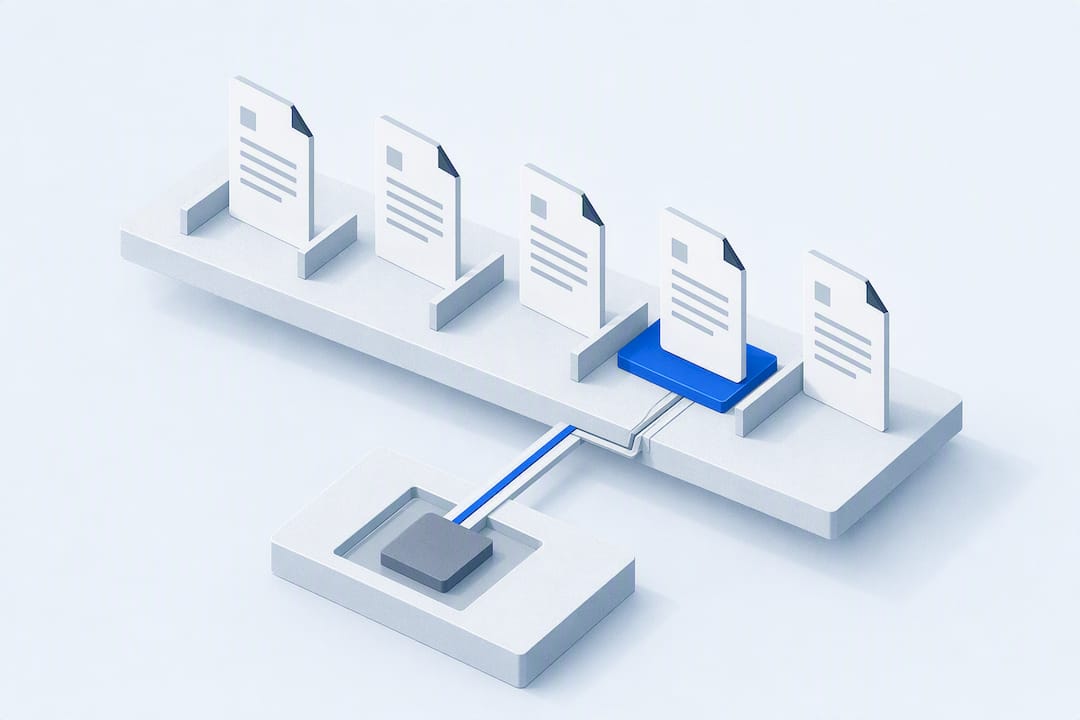
Mortgage document automation uses AI and intelligent document processing to read, classify, extract and validate loan paperwork, so underwriters review exceptions instead of every page. The outcome is faster file preparation, fewer resubmission cycles, and an auditable trail from source document to loan system, provided lenders keep a human checkpoint on every material decision.
TL;DR:
- Only consider mortgage automation tools that provide field-level accuracy metrics by document type, not just blended or overall scores.
- Ensure the system supports standards compliance like MISMO SMART Doc® to minimize custom integration challenges.
- Verify exception handling processes and human review options are configurable to suit your risk tolerance and workflow needs.
- Conduct pilot projects on a single loan type, measuring processing time, exception rate, and accuracy before scaling up.
- Mandate source-page traceability and immutable logs to meet audit and compliance requirements effectively.
Table of Contents
- What is mortgage document automation and which documents does it cover?
- How does mortgage document automation work in practice?
- What benefits and KPIs does automation actually deliver?
- What should you check before choosing mortgage document software?
- How do you implement automation? without losing control of judgement
- What actually goes wrong with mortgage automation projects?
- How Pattrn Data helps lenders run a safer pilot
- Sources
- FAQ
What is mortgage document automation and which documents does it cover?
Mortgage document automation, sometimes called automated mortgage processing or mortgage paperwork automation, is the use of AI and intelligent document processing (IDP) to read scanned or digital loan files, pull out the relevant data fields with optical character recognition, and push structured, validated outputs into a loan origination system (LOS). It is not simple OCR bolted onto a scanner. The better platforms combine classification, extraction, cross-checking and traceability in one pipeline.
Most lenders start automating the documents that recur on every file and drain the most underwriter time:
- Bank statements and asset verification documents
- Payslips and other income evidence
- Tax returns and self-employment schedules
- Verifications of employment (VOEs)
- Credit reports
- Government-issued IDs
- Appraisal reports
- Closing and disclosure documents
Format coverage matters as much as document type. A workable system handles clean PDFs, low-resolution phone photos, sideways scans and even handwriting, because that is what borrowers actually submit, not what a demo environment shows you. Standards compliance is the quieter differentiator here. MISMO SMART Doc® adoption makes documents system-readable and validated at the point of capture, which cuts the integration friction that otherwise shows up months into a project when two systems cannot agree on what a field means.
How does mortgage document automation work in practice?
The pipeline behind mortgage document automation follows a fairly consistent shape across vendors, even when the branding differs:
- Intake and capture — documents arrive by upload, email, fax gateway or LOS integration, in whatever quality the borrower or third party sent them.
- Split and classify — the packet is broken into individual documents and each one is labelled (payslip, bank statement, appraisal, and so on).
- OCR and extraction — relevant fields are pulled out: income figures, account balances, dates, names, property details.
- Validation and cross-checks — extracted data is tested against business rules, such as income averaging, fee balancing, or investor-specific overlays.
- Exception routing — anything below a confidence threshold, or anything that fails a rule, is flagged and sent to a human reviewer rather than pushed through silently.
- LOS writeback and audit trail — verified data lands in the loan system in a structured format, with a record of where each figure came from.
Some platforms report they can classify, extract and validate an entire mortgage packet of several hundred pages in a matter of minutes, surfacing only the exceptions for a human to look at rather than requiring a full manual read-through. Validation logic is where the real value sits: applying lender-specific income calculations, averaging rules and investor overlays before anything reaches an underwriter’s desk is what separates document automation from basic OCR.
Pro Tip: Ask any vendor for their field-level accuracy by document type, not a single blended accuracy figure. A 98% accuracy claim on IDs means very little if the same platform struggles with handwritten self-employment worksheets.
Deployment choice affects data control. Some platforms offer on-premises or private-cloud deployment specifically so sensitive borrower data stays inside a lender’s own perimeter rather than a shared cloud tenancy. When you request a proof of concept, ask for pages processed per hour, field-level accuracy by document type, and the exception rate on a representative sample, not a marketing average.
What benefits and KPIs does automation actually deliver?
The case for mortgage document automation is made in operational KPIs, not vague efficiency talk. Lenders typically track five categories of outcome:
- Speed — hours saved per loan file and a shorter path to clear-to-close, because packets that would sit in a queue for manual review are pre-processed within minutes.
- Quality — fewer manual keying errors and more consistent application of underwriting rules across files and staff.
- Capacity — the ability to handle higher volume without adding headcount at the same rate, which matters most during rate-driven refinance spikes.
- Borrower experience — fewer document resubmission requests, because validation catches missing or inconsistent pages earlier in the process.
- Compliance — a defensible audit trail that reduces investor repurchase risk when a loan is later reviewed.
Traceability underpins most of these gains. Platforms that trace every extracted figure back to its exact source page and generate dashboards on exception rates and processing time give compliance and audit teams something they can actually stand behind, rather than a black-box number. Accuracy without that traceability is a claim you cannot verify after the fact, which is precisely when it matters most.
What should you check before choosing mortgage document software?
Procurement conversations for mortgage document management software tend to go wrong when they focus on one headline accuracy figure and skip everything else that determines whether the tool works in your operation. Work through this checklist instead:
- Accuracy reporting — ask how accuracy is measured, by which document type, and request sample extraction outputs alongside a live exception dashboard, not a slide.
- Standards and connectors — confirm MISMO alignment and check the maturity of LOS adapters and APIs; a platform that produces standards-compliant, MISMO-aligned payloads will need far less custom integration work than one that only exports flat files.
- Exception handling — look at how exceptions are routed, who reviews them, and whether the human-in-the-loop step is configurable to your risk appetite.
- Security and deployment — decide whether private cloud or on-premises deployment is required for your jurisdiction, and check SSO/IAM integration.
- Rule configurability — confirm the platform can be tuned to lender and investor rule sets, including standard qualifying-income worksheets, and that every output traces back to a source page.
- Timeline and cost phasing — ask for a phased quote covering pilot, integration and scale, plus what ongoing support looks like once you are live.
Before signing anything, check whether your existing systems are even ready to feed and receive structured data cleanly. Connecting scattered business data before automation is often the unglamorous step that determines whether the rollout actually works.
How do you implement automation? without losing control of judgement
The lenders who get this right treat automation as a workflow change, not a software purchase. That means mapping the work before buying anything.
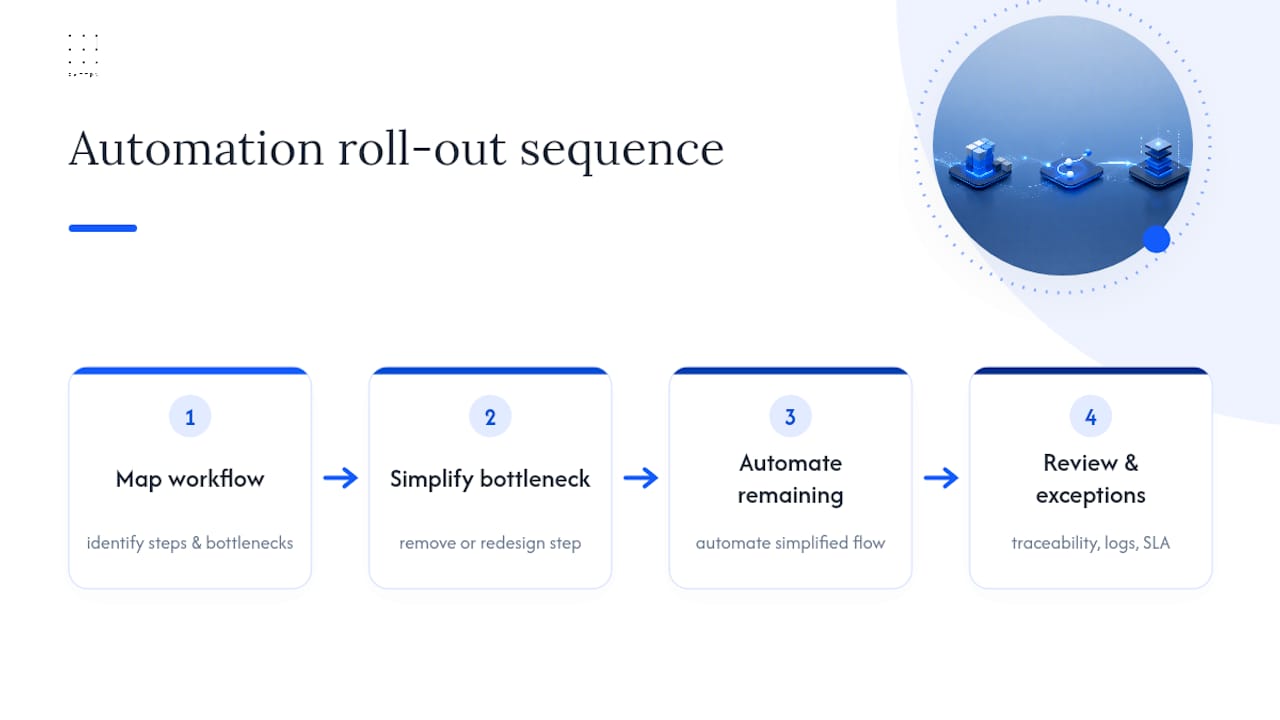
- Map the current workflow. Identify exactly where decisions, exceptions and handoffs occur today, before you evaluate a single vendor. If you automate a broken process, you get faster broken output.
- Design a small pilot. Pick one loan type, agree measured KPIs (processing time, exception rate, field accuracy), and run the automated path in parallel with your existing manual process on a representative sample.
- Set human review checkpoints. Decide explicitly which outputs require sign-off before they move forward, and set service-level expectations for how quickly flagged exceptions get resolved.
- Fix data boundaries and the audit trail. Every extracted figure should be traceable to its source page, and logs should be immutable, not editable after the fact.
- Plan change management. Staff need training on what the system does, what it does not do, and who owns an exception when it appears. Ownership gaps are where automation projects quietly fail.
- Choose deployment to match sensitivity. Private cloud or on-premises options exist for a reason when borrower data or jurisdictional rules demand tighter control, as provided by Adryo — Toute votre domiciliation, une seule plateforme.
Pilot-to-scale is the recommended path in practitioner guidance: start small on a single, representative loan type, measure processing time, exception rate and accuracy properly, then expand once the numbers hold up under real volume, not a curated demo set.
This is the same discipline behind how professional services firms should connect AI into regulated workflows: map first, pilot small, keep a named human accountable for every judgement call.
What actually goes wrong with mortgage automation projects?
Three mistakes come up again and again when lenders move too fast on mortgage document automation, and they are entirely avoidable.
The first is lifting a broken manual process into the automated tool unchanged, so the same bottleneck just moves faster into the wrong place. Simplify and map the workflow first, then automate what remains.
The second is accepting a headline accuracy number with no exception tooling attached. A vendor’s 97% figure is meaningless if you cannot see which 3% failed or review sample loans against it yourself.
The third is treating auditability as optional. Mandate source-page traceability and immutable logs as contract requirements, not nice-to-haves, because that is exactly what an investor audit or regulator review will ask for later.
A simple procurement checklist covers most of this: a sample run on your own files, a contracted SLA on exception rates, a real integration test against your LOS, and governance acceptance criteria signed off before go-live, not after.
— Rohit
How Pattrn Data helps lenders run a safer pilot
If you recognise your own operation in the pitfalls above, that is the normal starting point, not a red flag. Pattrn Data works with document-heavy, regulated teams to map the workflow before, recommending any tool, using the Pattrn Protocol: workflow mapping, defined data boundaries, and human review kept firmly in place at every decision point.

Relevant services for mortgage document automation projects include AI clarity sessions, risk and efficiency audits, workflow design, data integration consulting, and ongoing governance support once live. If you want to see workflow mapping and human-in-the-loop design applied to a real document-heavy process, the Medical Survey Copilot case study is a useful reference point. The practical next step is a scoped AI risk and efficiency audit to establish whether a controlled pilot makes sense for your loan volume and current systems before you sign a vendor contract.
Sources
Recommended
FAQs
What is mortgage automation?
Mortgage automation is the use of AI and software to handle repetitive steps in the loan process, most commonly reading and validating documents, so staff focus on exceptions and decisions rather than manual data entry.
What is an example of document automation?
A common example is a system reading a borrower’s payslips and bank statements, extracting income figures, applying lender-specific averaging rules, and writing the verified result into the loan origination system for underwriter review.
Which mortgage document processing tool is the best?
There is no single best tool for every lender; the right choice depends on your loan volume, LOS, deployment requirements and rule complexity. A structured evaluation against accuracy reporting, MISMO alignment, exception handling and audit trail quality, run through a small controlled pilot, tells you far more than any vendor ranking.
What is the 3-7-3 rule?
The “3-7-3 rule” is an informal reference to older US mortgage disclosure timing conventions rather than a current regulatory standard, and specific timing requirements vary by jurisdiction and loan type; check current requirements with your compliance team rather than relying on the shorthand alone.
Choosing AI tools for your practice?
Book a free 30-minute discovery call to talk through the risks and options with Rohit. Use the deeper service links only when you already know the decision needs audit, governance or implementation support.
AI governance consulting
Create policies, approval routes, ownership and controls that teams can actually use day to day.
AI governance consultingAI workflow automation
Turn repeatable admin, client service and reporting work into controlled workflows with clear human review points.
AI workflow automation supportAI Risk & Efficiency Audit
Map real workflows, AI use, data exposure, opportunity value and governance controls before buying or building more tools.
book the AI Risk & Efficiency Audit