
Map workflows first: operational governance that secures AI for SMEs

Short answer
Operational governance makes policy visible in the work: name who approves decisions, record exceptions and check that controls still operate after teams or systems change. Start with one consequential process.
Operational governance makes policy visible in the work: name who approves decisions, record exceptions and check that controls still operate after teams or systems change. Start with one consequential process.
TL;DR:
- Failing to establish clear ownership, evidence trails, and control points leads to unchecked automation and shadow AI risks.
- Map one bounded workflow, name its decision owners and test the proposed controls before expanding the scope.
- Regular review of automation and evidence collection at decision points prevents gaps during staff turnover or process changes.
- Risk-based audits focusing on sign-off trails and undocumented automation help identify and prioritize governance weaknesses.
- Conducting an AI readiness assessment and small pilot projects in advance embeds controls into workflows before scaling AI use.
Table of Contents
- What is operational governance and why does it matter?
- What are the core components of an operational governance framework?
- How do you find the biggest governance gaps?
- How do you actually implement or tighten operational governance?
- How does Pattrn Data apply this in practice?
- Why governance must lead AI adoption, not follow it
- Book an AI clarity session or risk audit with Pattrn Data
- Sources
What is operational governance and why does it matter?
Operational governance is the practical layer that sits below corporate governance. Where corporate governance sets strategy, values, and board-level accountability, operational governance decides how that strategy behaves inside a Tuesday afternoon workflow. The ICAEW describes this as the bridge between board intent and day-to-day management, and it’s a fair description: without that bridge, strategy stays theoretical and operations drift wherever habit takes them.
Use the benefits below as questions to test in a specific workflow, not as promised results of adopting a framework:
- Consistent decisions across teams, even when different people are handling the case
- Fewer internal conflicts over who was supposed to approve what
- Provable auditability when a regulator, client, or insurer asks “show me”
- Regulatory resilience because evidence already exists rather than needing to be reconstructed
- Safer automation because AI tools and Copilot workflows inherit clear boundaries instead of operating in a policy vacuum
For an AI-assisted process, turn the policy into visible steps: permitted inputs, review points, decision owners and an exception route. Test whether the people running the workflow can follow those steps, rather than checking only that a policy exists.
What are the core components of an operational governance framework?
Use the five components below as a working checklist. For each one, identify the person responsible, the decision they make and the record that shows what happened.
- Ownership and decision rights: name the person accountable for each decision type, not the team or department.
- Control definitions and enforcement points: specify what “approved” actually requires, and build that requirement into the system rather than a policy PDF.
- Evidence capture and audit trails: every approval, exception, and override needs a timestamped record that survives staff turnover.
- Review cadence and escalation paths: set how often controls get checked and exactly who gets notified when something breaches threshold.
- Interfaces with compliance, IT and security: governance that ignores data boundaries and access rights collapses the moment it meets a real system.
Pro Tip: Choose one consequential workflow and walk a recent case through all five components. Record missing owners, approvals or evidence before deciding which controls to extend elsewhere.
The NHI Mgmt Group’s definition of operational governance makes a similar point: governance only counts as such when approvals, actions, and exceptions are recorded in a way that makes the process provable, not just described.
How do you find the biggest governance gaps?
Run the questions below against a recent case and an exception in a consequential workflow. Distinguish a missing control from a control that exists but was not followed; the fixes may be different.
- Can you name, right now, who has authority to approve an exception on this process?
- If a client or regulator asked for evidence of that decision from six months ago, could you produce it in under ten minutes?
- Does any part of this workflow run through an AI tool, spreadsheet macro, or automation that nobody formally signed off?
- If the usual approver is on leave, does the process stop, or does someone quietly override it?
- Is there a written escalation path, or does everyone just message the same senior partner?
Score each workflow low, medium, or high risk based on how many of those questions expose a gap. A risk-based oversight approach recommends exactly this kind of triage: gather evidence from multiple points, weigh it by reliability and relevance, and put your assurance effort where the evidence actually points, not evenly across everything. High-risk gaps usually show up as missing sign-off trails, undocumented automation, or a single person carrying escalation informally in their head.
How do you actually implement or tighten operational governance?
Pilot the governance changes on one process. Define its boundary, decision rights and evidence points, then test an ordinary case and an exception before extending the model to other work.
- Map one workflow end-to-end before choosing any tool. Write down every step, every handoff, and every place a decision currently gets made, even informally.
- Define decision authorities and simple approval paths. One named owner per decision point, with a documented deputy for when they’re away.
- Instrument evidence capture at the points that matter. Not every step needs a paper trail, but every approval and every exception does.
- Run a small, controlled pilot on that single workflow, with human review kept explicitly in place at the riskiest steps rather than automated away.
- Build monitoring and risk-based assurance once the pilot proves stable, checking higher-risk processes more often than low-risk ones.
Pro Tip: Resist the urge to buy a dashboard before step one is finished. A governance framework built on data you can actually trust only works once the underlying workflow and evidence points are mapped. A dashboard on top of an unmapped process just automates the confusion.
The UK CAA’s oversight programme offers a useful pattern here, even for firms nowhere near aviation: annual audits paired with a mix of targeted inspections, so that oversight scales with risk rather than treating every process identically. Professional services firms can borrow that logic directly. Higher-risk client work gets checked more often; routine admin gets a lighter touch.
How does Pattrn Data apply this in practice?
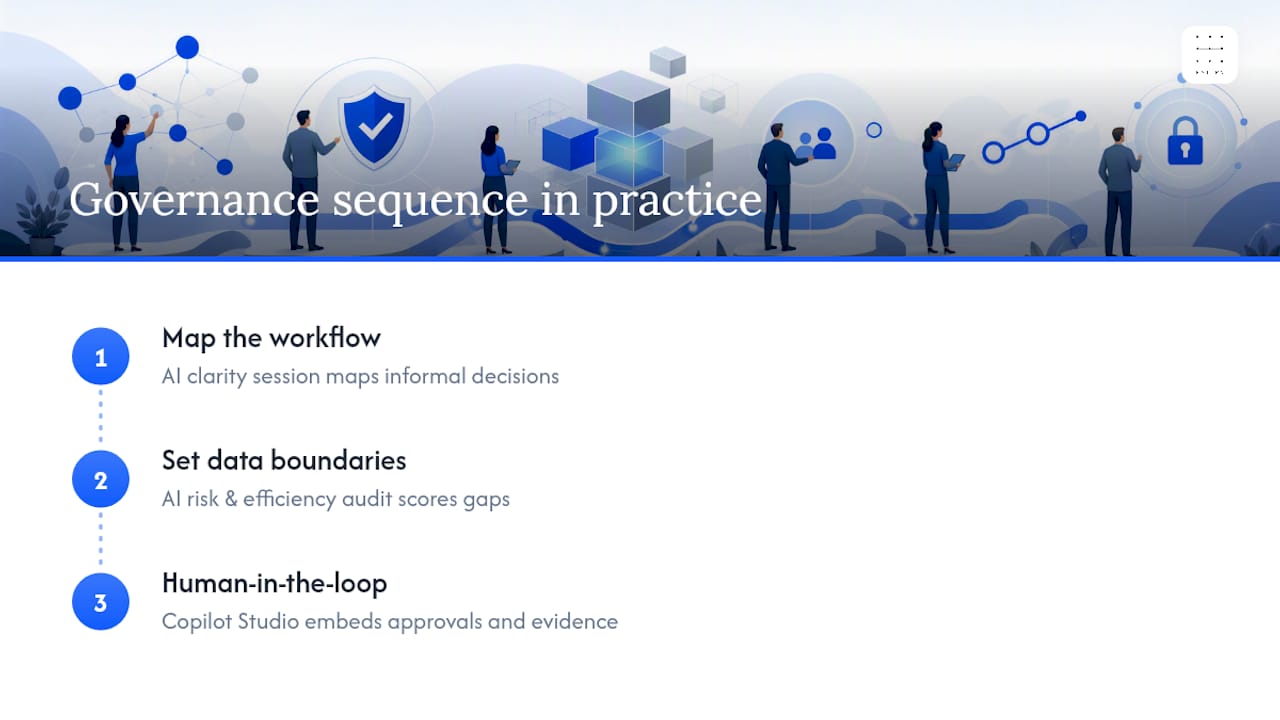
For a document-heavy AI workflow, map what enters the process, who may review it and who may authorise an action. Record the data boundaries and the route for work that falls outside them. That makes the proposed protocol testable on an actual case.
Map where casework decisions happen informally, identify the exposure created by each gap and assign a decision owner. If a Copilot Studio workflow is proposed, specify the approval and evidence points and test them before relying on the tool.
Governance that only exists on paper protects nobody when an automated workflow goes wrong at 11pm on a Friday. The point of mapping the workflow first is that the controls are already built into the system before anything runs unattended.
Why governance must lead AI adoption, not follow it
Before buying a tool, agree its permitted uses, data boundaries and approval process. Ask staff how they currently complete the task and where that process creates pressure to work around it. Treat unapproved use as something to investigate, not an inevitable result of one procurement order.
Use the pilot to test ownership, data boundaries and review decisions, not just whether the tool runs. Record exceptions and unresolved questions, then decide whether to change, pause or extend the process.
Rohit
Book an AI clarity session or risk audit with Pattrn Data
An alternative to bolting AI onto an ungoverned process is to map the workflow, set the data boundaries, and keep human review exactly where judgement still matters.

That starts with an AI Readiness Assessment for SMEs, a fixed-price way to see where decision rights, evidence trails, and automation boundaries already exist, and where they don’t. From there, an AI clarity session or a full risk and efficiency audit builds the missing pieces properly: Copilot workflow design, ongoing managed AI governance and support, or a scoped implementation project depending on what the gap analysis shows. If you need a rehearsed answer for when a client or regulator asks how your AI use is governed, that’s worth working through before it’s asked, not after.
Book an AI clarity session and get a clear map of where your governance already holds and where it doesn’t.
Sources
Recommended
Related services
AI governance consulting
Create policies, approval routes, ownership and controls that teams can actually use day to day.
AI governance consultingAI workflow automation
Turn repeatable admin, client service and reporting work into controlled workflows with clear human review points.
AI workflow automation supportAI Risk & Efficiency Audit
Map real workflows, AI use, data exposure, opportunity value and governance controls before buying or building more tools.
book the AI Risk & Efficiency Audit