
Audit Ready Self Hosted AI For Professional Firms: 7 Fields
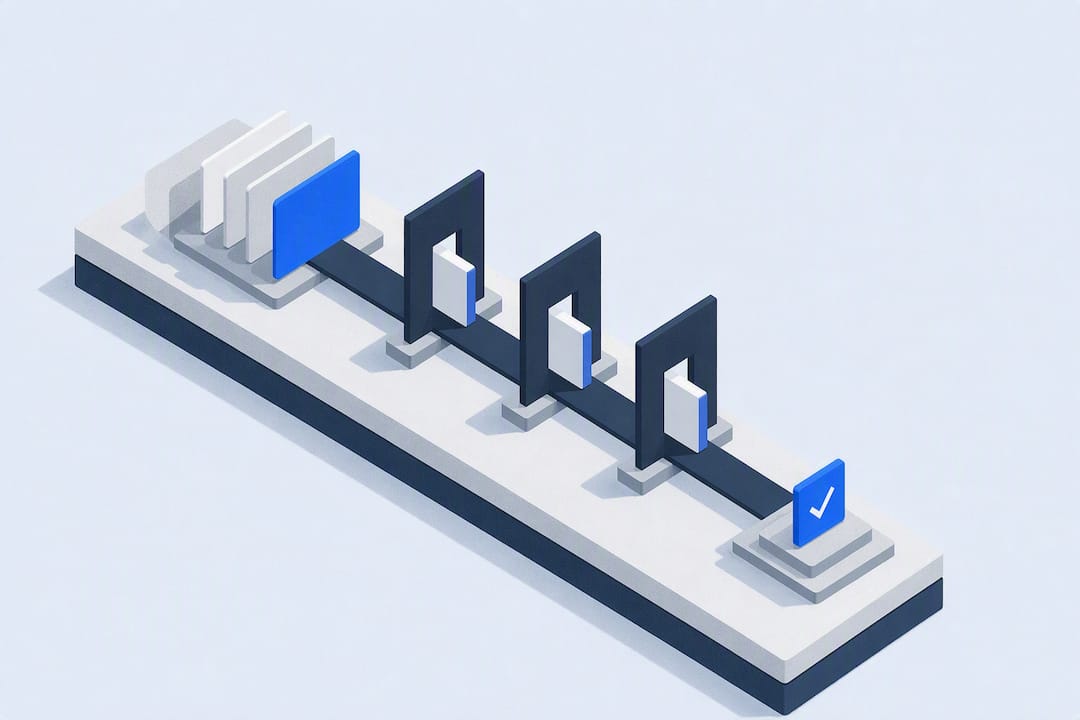
A self-hosted AI assistant, for a professional services firm, is a private and governed workspace, not a hobbyist chatbot on someone’s laptop. It sits inside your systems, connects to your data under defined boundaries, and pairs a trust layer with an audit trail before it acts. The right first move is a single controlled pilot, mapped to one workflow, with human approval built in from day one. Governance-aware options exist precisely to make that pilot structured rather than improvised.
TL;DR:
- A controlled pilot should focus on a single workflow with human approval and clear boundaries before scaling AI deployment across a firm.
- An effective audit trail must include trigger details, model version, AI output, actions taken, approvals, timestamps, and downstream outcomes, all linked through correlation IDs.
- Governance requires a named owner responsible for AI decisions, with defined thresholds, escalation procedures, and verified vendor data provenance to ensure compliance.
- Regular reviews, versioning, and rollback plans are essential to maintain model performance and adapt to vendor updates or workflow changes over time.
- Staff must be trained on the assistant’s scope and security features, with mechanisms to flag issues easily to foster trust and proper adoption.
Table of Contents
- What makes a self-hosted AI assistant fit for a professional firm?
- How do you design an audit trail that actually holds up?
- How do you deploy a self-hosted AI assistant step by step?
- Who owns AI governance and what must leaders decide first?
- How do you keep a self-hosted AI assistant reliable over time?
- What backup and disaster recovery does a self-hosted system need?
- How do you get staff to actually trust and use it?
- What resourcing does a self-hosted assistant need as you scale?
- Author perspective: how the Pattrn Protocol and Artha apply this guidance
- How Pattrn Data can help you build this properly
- Sources
- FAQ
What makes a self-hosted AI assistant fit for a professional firm?
An assistant that recommends and one that executes are two different risk categories, and treating them the same is where most firms come unstuck. The features below separate a genuinely governed system from a chatbot with extra plumbing.
A governed AI assistant needs a trust layer that combines policy, decision rights and human review with technical guardrails and evidence capture, according to EY’s enterprise AI governance research. That layer is not a settings toggle. It is a set of enforced rules about who can approve what, under which conditions, and what happens when those conditions are not met.
Look for these features before you sign off on any deployment:
- A trust layer with roles and thresholding. Policies, permission checks and escalation triggers built into the workflow, not bolted on afterwards.
- Audit-grade logging with correlation IDs. Every automated action traceable back to the business event that triggered it.
- In-flight redaction before data reaches the model. Sensitive fields stripped or masked at the point of entry, not cleaned up after the fact.
- Clear separation between recommendation and execution. The assistant can suggest a client email; a human decides whether it sends.
- Integration controls covering SSO, SCIM and OAuth token lifecycle. Every connected app inventoried, every token with an expiry date.
Most of the audit trail specification below rests on one principle: if an action wasn’t logged with context, it didn’t happen in a way you can defend. That is the standard regulators and insurers will eventually hold you to, whether or not it feels like overkill on day one.
Data ownership deserves its own line of scrutiny. Ask any vendor directly whether they train on your customer data, and get the answer in writing before any pilot data leaves your systems. Encryption at rest and in transit, plus an external key management (EKM) option where you hold the keys independently of the vendor, should be table stakes rather than a premium add-on.
How do you design an audit trail that actually holds up?
Most audit trails fail not because firms forget to log activity, but because they log the wrong things. A timestamp and a green tick are not evidence; they are decoration.
An audit-ready workflow needs to capture seven fields for every AI Execute action, according to Rework’s guidance on audit trails for AI execute actions: the trigger, the model and prompt template used, the AI’s output including its reasoning, the action taken, the human approval or threshold rule that permitted it, the timestamp and context, and the downstream outcome. Miss one of these and you cannot reconstruct what happened when a client complains or a regulator asks.
| Field | What it captures | Why it matters |
|---|---|---|
| Trigger | The business event that started the workflow | Anchors the log to something real, not a technical timestamp |
| Model & prompt template | Which model version and instructions were used | Lets you reproduce or challenge the output later |
| AI output | The recommendation, including its stated reasoning | Shows what the system actually proposed |
| Action taken | What was executed as a result | Distinguishes a suggestion from a real-world effect |
| Approval or threshold rule | Who approved it, or which rule allowed it to proceed automatically | The core of defensibility |
| Timestamp & context | When and under what conditions | Places the event in a reconstructable sequence |
| Outcome | What happened downstream | Confirms whether the action achieved its intended result |
The audit trail should link request context, AI output, controls, human review and final outcome as one connected chain, not scattered logs across three systems, according to Workhint’s audit trail guide for business teams. A correlation ID, propagated through every system the action touches, is what stitches that chain together.
Store references and hashes rather than raw payloads wherever you can. A pointer to the client file and a hash of its contents proves what was reviewed without duplicating sensitive data into a third system. Retention periods should track whatever regulatory regime applies to your sector, whether that means SOX-style financial record retention, HIPAA-adjacent health data rules, or the documentation expectations building around the EU AI Act.
Pro Tip: Anchor every log entry to a business event, not a technical one. Teams that log prompts in isolation, without tying them to the client matter or transaction that triggered them, consistently fail their first audit because nobody can answer “why did this happen?” from the logs alone.
How do you deploy a self-hosted AI assistant step by step?
Skipping straight to tool selection is the single most common mistake firms make. The workflow, not the software, should set the boundaries.
- Define the workflow boundary and name an owner. Pick one workflow (client onboarding, document review, follow-up chasing) and one person accountable for it.
- Instrument data discovery and classify what’s sensitive. Know which fields are personal, financial or privileged before anything touches a model.
- Apply prompt-level redaction. Strip or mask sensitive fields before they reach the assistant, not after.
- Set approval thresholds and test incident reconstruction. Deliberately try to rebuild a decision from the audit trail alone. If you can’t, the schema is incomplete.
- Govern every OAuth token and integration. Catalogue each connected app, set expiry dates, and plan how you’ll decommission access when a tool or a staff member leaves.
- Measure the pilot and iterate. Track override rate, error types and genuine time saved, then decide whether to widen scope.
Pro Tip: Run the incident reconstruction test in step four before you go live, not after something goes wrong. If your team can’t answer “who approved this and why” within five minutes using only the logs, fix the schema before adding a second workflow.
Who owns AI governance and what must leaders decide first?
Governance fails quietly when nobody owns it. A firm needs a named person accountable for AI decisions, not a committee that meets when something breaks.
Before any assistant goes near live client work, leadership needs to settle:
- Accountability. One accountable AI lead, named workflow owners, and a line to board-level oversight for anything touching client money or advice.
- Acceptable use and thresholds. What the assistant may do unattended, what always needs sign-off, and how approvals expire.
- Escalation and retention. Who gets notified when a threshold is breached, and how long records are kept.
- Vendor due diligence. Verified data provenance and a documented check on every supplier in the chain, not just the primary vendor.
This last point matters more than firms expect. Governance requires a whole-of-value-chain approach, inventorying AI systems and verifying data provenance across suppliers and partners, according to OECD due diligence guidance for responsible AI. A tool you trust might still pull in a sub-processor you’ve never vetted.
Token lifecycle policy belongs on this list too. Every OAuth grant needs an owner and an expiry, particularly when staff leave or a tool falls out of use. Stale integrations are a quiet way for access to outlive its purpose.
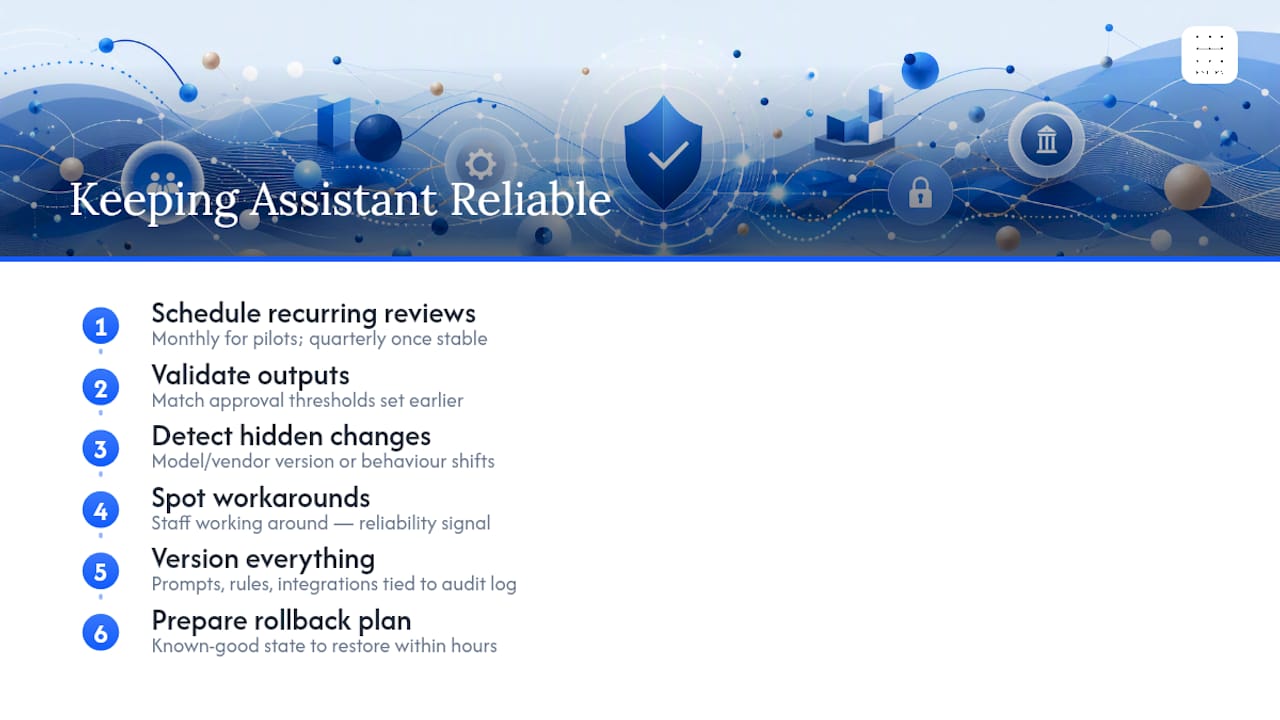
How do you keep a self-hosted AI assistant reliable over time?
A model that performed well at launch will drift. Vendor updates change behaviour, prompt templates go stale, and the workflow it was built for evolves without anyone updating the assistant to match.
Schedule a recurring review, not an annual one. Monthly is realistic for a single pilot workflow; quarterly at most once the system is stable. Check three things each time: whether outputs still match the approval thresholds you set, whether the model or vendor has changed underlying versions without telling you clearly, and whether staff have started working around the assistant rather than through it. That last signal, quietly, is the most honest measure of reliability you have.
Version everything. Prompt templates, approval rules and integration configurations should each carry a version number tied to the audit log, so a reviewer investigating an incident from three months ago can see exactly which ruleset was live at the time. Treat a model or prompt update the same way you’d treat a change to a compliance procedure: documented, dated, and communicated to everyone who relies on it.
Build a rollback plan before you need one. If an update degrades output quality or breaks an integration, you need a known-good previous state to return to within hours, not days. Firms that skip this step tend to discover the gap during an incident, which is the worst possible time to learn it.
What backup and disaster recovery does a self-hosted system need?
A self-hosted assistant carries a dependency most firms overlook: if the infrastructure goes down, so does every workflow that now routes through it, including ones humans used to do without any system at all.
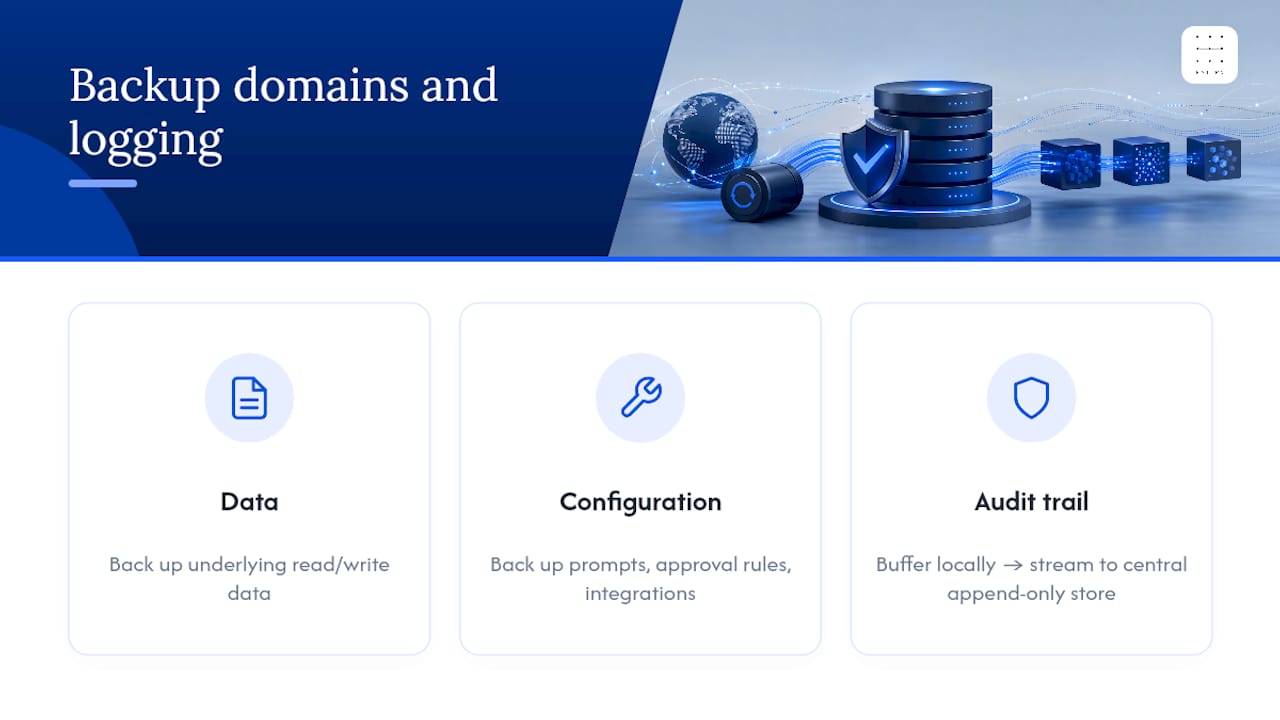
Back up three things separately: the underlying data the assistant reads and writes, the configuration (prompts, approval rules, integration settings), and the audit trail itself. Losing the audit trail after an incident is arguably worse than losing the workflow, because it removes your ability to explain what happened during the outage. A hybrid logging approach, buffering locally for performance and streaming to a centralised, append-only store for durability, gives you resilience on both fronts.
Test recovery, not just backup. A backup nobody has restored is a hope, not a plan. Run a recovery drill on the pilot workflow specifically: simulate the assistant going offline mid-task and confirm the workflow can fall back to a manual process without losing the audit chain for that in-flight action.
Firms weighing infrastructure options for this kind of resilience often find lightweight, well-scoped hosting patterns outperform over-engineered enterprise setups for a single-workflow pilot, a point covered well in Zenvor’s guidance on cloud hosting for startups. Right-sizing the infrastructure to the pilot avoids both under-provisioning and paying for capacity you don’t yet need.
How do you get staff to actually trust and use it?
The best-governed assistant fails if the people meant to use it route around it. Adoption is a change management problem before it’s a technical one.
Start training with the boundary, not the features. Staff need to know precisely what the assistant can suggest and what it can never do without sign-off, because ambiguity here is what pushes people towards shadow AI use on personal accounts. Show them the approval gate in action on a real example from their own workflow, not a generic demo.
Give staff a fast way to flag a bad output. If the override process is slower than just doing the task manually, people will quietly stop using the assistant and nobody will tell you why usage dropped. Track override rate deliberately during the pilot; a high rate isn’t necessarily failure, it might mean the guardrails are working exactly as intended.
Involve the workflow owner from step one of the deployment checklist in training design, not just IT. They understand the exceptions and edge cases that a generic rollout script will miss entirely.
What resourcing does a self-hosted assistant need as you scale?
A pilot running one workflow for one team has very different resource needs to the same assistant supporting five departments. Scaling changes the maths on infrastructure, integration load and governance overhead all at once.
Plan integration capacity before you plan compute. Each new connected system adds an OAuth relationship, a data flow to classify, and an audit trail branch to maintain. Vendor and OAuth token inventory is frequently overlooked as firms scale, and governance needs a defined lifecycle policy for every integration bridge to avoid silent long-running exposures. A firm with three integrations at pilot stage can find itself managing fifteen within a year if nobody owns the inventory.
Approval capacity is a resourcing question too, not just a technical one. If your threshold rules route more decisions to human review as usage grows, you need enough qualified reviewers to keep pace, or the approval queue becomes the actual bottleneck, not the model. Build this into headcount planning rather than discovering it when a queue backs up during a busy quarter.
Author perspective: how the Pattrn Protocol and Artha apply this guidance
Most of the friction I see comes from firms choosing the tool before they’ve mapped the workflow, then trying to retrofit governance afterwards. It rarely holds up under scrutiny.
A workable pattern looks like this: a client query comes in, the assistant drafts a recommendation, a named approver reviews it against a threshold rule, and only then does an action fire, with every step written to the audit record automatically. That sequence is what the Pattrn Protocol maps out before any tooling is chosen, and it’s the same logic behind Artha, Pattrndata’s private AI workspace built for exactly this kind of approval-led work.
— Rohit
How Pattrn Data can help you build this properly
Getting a self-hosted AI assistant right is less about picking software and more about deciding, in advance, what it’s allowed to do without you in the room. That’s the part most firms underestimate, and it is crucial to sort out before a single workflow goes live.

An AI clarity session maps your current workflows and shows exactly where an assistant would touch client data, approvals and existing systems, before you commit to anything. From there, an AI Readiness Assessment scopes a controlled pilot with the audit trail, approval thresholds and integration inventory built in from the start, rather than added once something has already gone wrong. For teams already running Artha or considering it, the same governance discipline applies: workflow boundaries first, tooling second. If you’re weighing up how AI tools should connect to your SSO and identity systems, that’s exactly the kind of question a readiness assessment answers before deployment, not after. Book the assessment and get a scoped, working pilot plan rather than a vague roadmap.
Sources
Recommended
FAQs
What is a self-hosted AI assistant for a professional firm?
It’s a private, governed AI workspace deployed inside your systems with defined data boundaries, human approval gates and audit logging, rather than a public chatbot used ad hoc by staff.
What’s the difference between a personal AI assistant and this kind of deployment?
A personal assistant runs unsupervised for one individual; a business-grade deployment enforces approval scopes, logs every execute action, and separates recommendation from execution across a whole team.
What are the seven fields an audit trail needs?
Trigger, model and prompt template, AI output with reasoning, action taken, human approval or threshold rule, timestamp and context, and downstream outcome, as set out in Rework’s audit trail guidance.
How long should a pilot run before scaling?
Long enough to test incident reconstruction, measure override rate and confirm the approval workflow holds under real client volume, typically a defined single workflow over several weeks rather than a fixed calendar period.
Can Pattrndata help build one of these systems?
Yes. Clarity sessions, readiness assessments and managed AI workspace solutions are built around the same governance-first sequence described throughout this guide: map the workflow, set the boundaries, then choose the tool.
Choosing AI tools for your practice?
Book a free 30-minute discovery call to talk through the risks and options with Rohit. Use the deeper service links only when you already know the decision needs audit, governance or implementation support.
AI governance consulting
Create policies, approval routes, ownership and controls that teams can actually use day to day.
AI governance consultingAI Risk & Efficiency Audit
Map real workflows, AI use, data exposure, opportunity value and governance controls before buying or building more tools.
book the AI Risk & Efficiency AuditAI workflow automation
Turn repeatable admin, client service and reporting work into controlled workflows with clear human review points.
AI workflow automation support